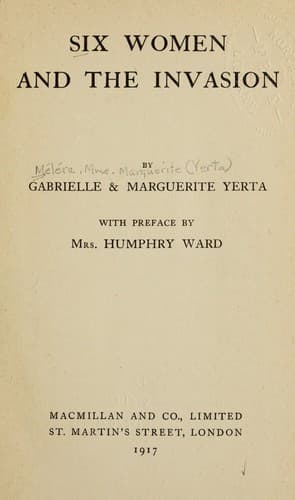
Six Women and the InvasionMéléra, Marguerite-Yerta
History
Six Women and the Invasion
Méléra, Marguerite-Yerta
World War, 1914-1918 -- Personal narratives
To Cerny also belonged those seven men who had been confined in the
_mairie_ of Chamouille, and who saw an officer come up and yell in a
furious tone: "Your dirty French have discovered our presence here. One
of you must have made signals. That's why we are getting a shower of
shrapnel." The civilians denied the charge, and defended themselves. To
no purpose.
"You shall spend the whole night in front of the house, and if you get
knocked on the head, it will serve you right."
The men were drawn up in the street, and from evening till morning stood
there within reach of their guards' revolvers. As if by miracle, the
cannonade ceased, and during the night not a shot was fired upon the
village. The next day the prisoners were sent to Laon.
Less tragic but just as remarkable, was the story of our companions
Noreau, the grandmother, so small, so weak, that we more than once
thought her death near at hand, and her darlings, with their pale faces
and their eyes encircled with black. Major Noreau owned a large house in
Coucy. It pleased the invaders, in their omnipotence, to take possession
of eleven rooms, and to establish their offices in them. The owners had
but the use of a single room, reserved for the sick father. Mme. Noreau,
her four children and her mother-in-law, slept all the winter in a cold
attic. Some of them slept on straw, but the old grandmother had, instead
of a bed, ... a kneading-trough!
All the furniture had been carried away, scattered about the village, or
over the trenches. To crown all, the family had suffered hunger almost
unceasingly. Coucy had been still less favoured with provisions than
Morny, and only the farmers had managed to lay by some few articles of
food.
"One day," our old friend told us, "little Mimi picked up from the
dunghill a lump of sugar an officer's servant had thrown to the dog. She
knew her mother had had no food the last two days, and brought her this
windfall."
The same little Mimi, after she had slept on straw for months together,
forgot, for want of practice, her normal vocabulary, such words, for
instance, as sheet, and the first evening she asked Antoinette, who had
adopted her:
"What is the name of those things ... you know what I mean ... those
white things one stretches upon the beds?..."
A great many emigrants were thrown out of their villages in September,
when the Germans had been driven back. They had been pushed forward like
cattle, had been penned up in the citadel of Laon, and left there for
weeks, for months, sleeping on straw and starving. All these unhappy
wanderers were stranded at Jouville. They had met again with their old
companion Hunger. They were persecuted by the cold. Many lay groaning in
the icy cellars of the sugar-mill, or in the airy attics of the farm.
Public-domain text, read in full here on John Shaqi.
Reviews
Reviews
No reviews yet
Be the first to share your thoughts on this work.
Elsewhere in the archive
Join the Discussion
Join the discussion
Sign in to leave a comment or review.
Sign InorCreate an account