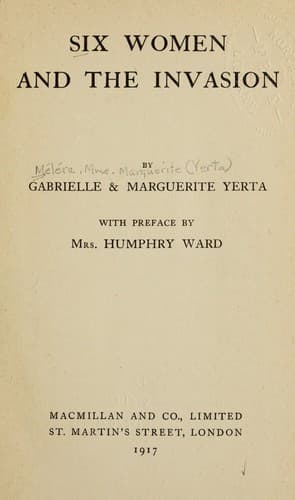
Six Women and the InvasionMéléra, Marguerite-Yerta
History
Six Women and the Invasion
Méléra, Marguerite-Yerta
World War, 1914-1918 -- Personal narratives
Such, for instance, was this lieutenant quartered in Laon, who confided
to every one willing to listen to him:
"I don't care a fig for the fate of Germany! If only the war would end
soon, and I could get on with my studies and make myself a good position
after.... I should be content."
Of the same kind was the young commandant of the village, lamed by a
fall from his horse.
"The war!" he said, "what do I care for it? I am unfit for fighting, do
you see. I shall neither be killed nor mutilated, and it is all one to
me how long the war will last. I have comfortable rooms, and get good
dinners without untying my purse-strings. I am well paid, and able to
save. When we are at peace again I shall have a jaunt, and then go back
to Germany. Men will be rare, and I shall marry whom I choose, the
richest girl I can hear of, of course. My future is assured, and so I
am quite easy in my mind."
We thought still more disgusting those who first-cared-for-their-skin.
We were pleased to observe not a few cowards who strove with feet, hand,
and purse to avoid danger and keep behind the line.
Love of life, self-esteem, a dislike for bloodshed, and a natural dread
of blows kept them from the front. They thought but of one goal: to
cling at any price to safety.
I wrote "at any price" on purpose. Several of them boasted they had paid
for not being sent to the front. Where, when, how, to whom, I do not
know. By what mysterious bribery, by what surreptitious palm-greasing
other people will perhaps establish. The truth of such things is not
easy to ascertain. I can only state that two officers and a sergeant,
belonging to different regiments, told those in whose houses they
lodged, one in Laon, the others in Morny and Jouville, that they had
paid from 4000 francs to 6000 francs to get leave to keep out of
danger's way. Thus they obtained a few months' respite, after which they
had to pay again or endanger their lives.
When we were at Jouville, a stout sergeant, nicknamed Tripe, well-nigh
died of an apoplectic stroke on hearing he was ordered to go to the
front. "I have paid 4000 francs to be exempted from fighting. I thought
the war wouldn't last so long! And now I have no money left!" Mad with
rage, he dashed his helmet right across the room, and this martial
attribute was picked up with its point all awry. As to private soldiers
who told their hosts they had acted in the same way, I will not even try
to count them, they are too many.
The other officers owned a certain number of qualities in common.
According to the individuals, one of these characteristics eclipsed the
others, and the dominant feature helped us to classify the fools.
Public-domain text, read in full here on John Shaqi.
Reviews
Reviews
No reviews yet
Be the first to share your thoughts on this work.
Elsewhere in the archive
Join the Discussion
Join the discussion
Sign in to leave a comment or review.
Sign InorCreate an account