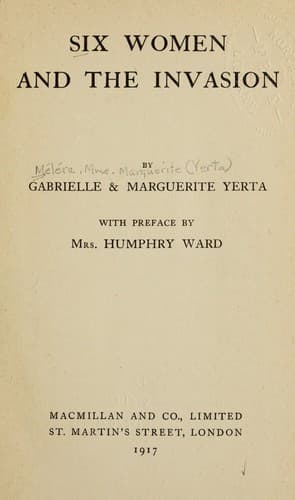
Six Women and the InvasionMéléra, Marguerite-Yerta
History
Six Women and the Invasion
Méléra, Marguerite-Yerta
World War, 1914-1918 -- Personal narratives
Of the sentimentalists, Herr Mayor was the best specimen. His eyes cast
upon the blue sky, he murmured his regrets in a voice broken by tears:
"His wife ... so many griefs ... and so many dead ... how dreadful is
war! If only we could make a Holy Alliance of the peoples!" I must say
that Herr Mayor kept his sensibility in his pocket, and took it out only
at dessert. In the discharge of his duties he forgot this faculty
completely.
The pompous officers were more entertaining. Such was a certain cavalry
officer who at the end of September put up for a few days at M.
Lonet's. His name ended in "ski," he twirled his mustachio after the
Polish fashion, and drew himself up most elegantly. Once upon a time he
happened to go through the drawing-room, where Geneviève was talking
with Mme. Lonet. The surprise sent a thrill through him: "Why! two
pretty women! Quick! let us show off!"
And the braggart began to hold forth in praise of Germany.
"Ah! _mesdames_, the emperor is extremely satisfied with the march of
our army. Our gallant soldiers laugh at obstacles, and advance as if by
miracle."
This speech was made shortly after the battle of the Marne.
Unfortunately the hearers, as well as the orator, were unacquainted with
the event, which, had they known of it, would have given yet more
meaning to the gentleman's discourse.
The same _Rittmeister_ could not refrain from delivering high-sounding
addresses to all whom he met. In case of need he even fell back on the
man who split the wood or the maid of all work. "Have you seen," he
would say, "have you seen our splendid Imperial Guard? Have you noticed
the gait of our soldiers? Do you know that no troops in the world are to
be compared with them?" And for a revictualling cart that rattled by,
for a soldier's shirt drying on a hedge, he would pour forth his soul in
dithyrambs on Germany's greatness, invincibility, and might. You will
think, no doubt, that the first and foremost soldier of the Prussian
army, the supreme chief of our enemy, would take his place, not without
the radiance of a star, among his _confrères_ of pomposity.
Another pompous talker, a sub-lieutenant and former law student, lodged
in the spring of 1915 at Mme. Lantois'. He set up for a linguist, and
wanted us to believe he knew French better than we. Once I brought him a
demand-note to sign. He carped at a word I used. I tried to defend my
prose, but he stopped me with a motion of his hand:
"I know the word and how to use it."
Public-domain text, read in full here on John Shaqi.
Reviews
Reviews
No reviews yet
Be the first to share your thoughts on this work.
Elsewhere in the archive
Join the Discussion
Join the discussion
Sign in to leave a comment or review.
Sign InorCreate an account