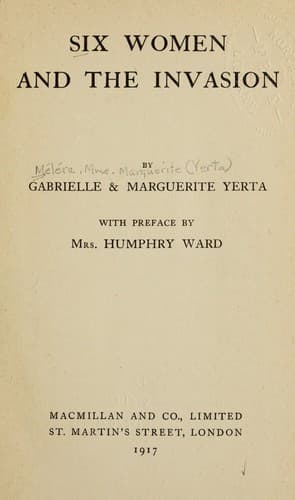
Six Women and the InvasionMéléra, Marguerite-Yerta
History
Six Women and the Invasion
Méléra, Marguerite-Yerta
World War, 1914-1918 -- Personal narratives
No doubt the Commandant was of the same race as the Von Bernhausens or
the Bubenpechs, whom Madame Yerta pillories in these lively and
sarcastic pages. It would be too much indeed to expect that any
Frenchwoman who had passed through fifteen months of such a life should
write with complete impartiality of her temporary masters. She would be
less than human were it possible. Yet in the sketches of the two German
officers "Barbu" and "Crafleux," billeted on the "six women," there is
no more than a laughing malice, and an evident intention to be fair to
men who had no evident intention to be cruel. But of the bullying
Commandant, Lieutenant von Bernhausen, and of the officer, Lieutenant
Bubenpech, who succeeded him as the absolute master of the French
village which is the scene of the book, Madame Yerta gives us portraits
in which every touch bites. The drunken, sensual manners of such men,
combined with German conceit and German arrogance, make up a type of
character only too real, only too common, to which throughout the
districts where the Germans have passed, French experience bears
inexorable and damning witness.
It is clear, however, that these six brave women--Madame Valaine, her
four daughters and her daughter-in-law, the writer of the book--were
well able to take care of themselves. The tale of their courage, their
gaiety, their resource under the endless difficulties and petty
oppressions of their lot, lights up the miserable scene, kindling in the
reader the same longing for retribution and justice on a barbarian race,
as burnt in their French hearts.
Madame Yerta describes for us how neighbours helped each other, how they
met in the farm kitchens, behind their closed doors and windows, to pass
on such news as they could get, to pray for France, and scoff at the
invader; how they ingeniously hid their most treasured possessions, how
they went hungry and cold because the Germans had robbed them of food,
clothing and blankets--(they are doing it afresh at this very moment in
occupied France and Belgium!)--and how village and town alike would have
starved but for the Spanish-American Relief Commission.
The result is a typically French book, both in its lightness of touch
and in the passionate feeling that breaks through its pages. The old
Latin civilisation makes the background of it--with its deeply rooted
traditions, its gifts of laughter and of scorn, its sense of manners and
measure, its humanity, its indomitable spirit. When the writer at last,
after fifteen months of bondage, sees once more the fields of "la douce
France," she puts simply and sharply into words the thoughts and
sufferings of thousands--thousands of ill-treated, innocent and
oppressed folk--to whom, as we pray, the course of this just war will
before long bring comfort and release.
Her book deserves a wide audience, and will, I hope, find it.
MARY A. WARD.
_September 1917._
CONTENTS
Public-domain text, read in full here on John Shaqi.
Reviews
Reviews
No reviews yet
Be the first to share your thoughts on this work.
Join the Discussion
Join the discussion
Sign in to leave a comment or review.
Sign InorCreate an account