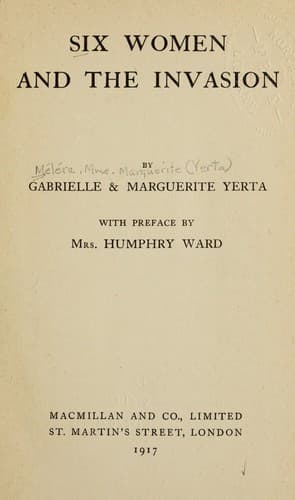
Six Women and the InvasionMéléra, Marguerite-Yerta
History
Six Women and the Invasion
Méléra, Marguerite-Yerta
World War, 1914-1918 -- Personal narratives
Our own house is greatly alarmed. Mme. Valaine does not know which way
to turn. "Make haste, we must go at once. Get our things ready."
Thinking Laserbe would take us, we had packed up just what was
necessary, and what was necessary meant thirteen bags. We must discard
them. Feverishly we unpacked and abandoned the heavy bags; bundles would
do. A little linen, one or two light dresses, cloaks, shawls, a basket
filled with food, and we were quite ready. Had I not early in the
morning buried in the depths of the garden a sealed-up glass jar full of
jewels? And with the gold pieces my mother-in-law had brought from
Paris, had I not made a band I wore around my waist? We were ready, no
doubt of it.
We did not know what to do with the bags we were bound to abandon. We
dragged them upstairs to a loft next my bedroom, thrust them into it all
topsy-turvy, and hurriedly heaped up big logs at the entrance.
Everything was in order; the dogs were on their chains; we had but to
go.
Here we are in the street, all doors shut, and off we go. We wait one
minute to calm our hearts and to drop a tear.
Dear little house, white walls, virginia creepers, when shall we meet
again? And what will you look like? Let us begone! It is time for
action, not for regret.
Our neighbours next door, the couple Tillard, were putting the donkey in
their cart all ready for flight.
I have read somewhere that people should help one another in misfortune,
and so I blurted out: "Oh, M. Tillard, I suppose you are driving to 'the
mountains.' We are going too. Would you kindly take one of our parcels
with you?" At a loss what to answer, Tillard muttered between his teeth:
"Hum! already loaded.... Don't know which way...."
That is enough. "Thank you.... I understand." Another pause, this time
at M. Lonet's, my mother-in-law's brother. Stern-faced, with knotted
brows, our uncle refuses to go. Not he! He is fonder of his house, of
his gardens, than of anything, and the Germans cannot scare him away. He
bends on our caravan a glance of mingled scorn and pity, and, on going
out, Geneviève whispered in my ear as a last protest:
"He is not a coward."
If fear could not enter M. Lonet's heart, it reigned in the village. The
whole place was deserted, and we were among the last to go. Here and
there a flickering light showed that hasty preparations were still being
made in a few houses. Terror oozed from the closed shutters, hostile to
the expected foe, and from the doors, which presently the dwellers would
half open, to sneak away. At the end of the village, in a yard, a
lantern moved to and fro, a horse was harnessed, people hurried up and
down.
"Lucky rogues," Colette cried out, "who possess a cart!"
Public-domain text, read in full here on John Shaqi.
Reviews
Reviews
No reviews yet
Be the first to share your thoughts on this work.
Join the Discussion
Join the discussion
Sign in to leave a comment or review.
Sign InorCreate an account