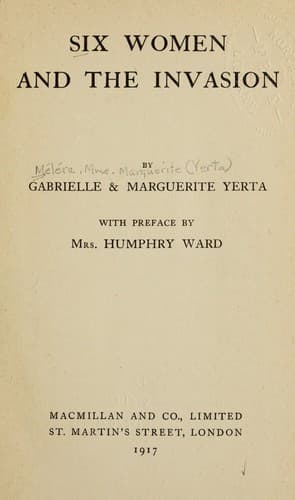
Six Women and the InvasionMéléra, Marguerite-Yerta
History
Six Women and the Invasion
Méléra, Marguerite-Yerta
World War, 1914-1918 -- Personal narratives
The churchyard is terraced to the street, which runs down a steep hill,
and thence already we caught sight of a few horsemen, closely followed
by soldiers on foot. They were French. At the sight of the enemy, our
grief, all of a sudden, turned to wrath and madness. Here they were in
our own country, the very same we saw yesterday, no doubt. They were
those perhaps who had blinded and killed the scout, and they were
taking our brothers to captivity. Oh, for the power to strike, to kill
those men! To hurl down upon them some of those big stones, half
loosened by time! We shuddered at the mere sight of them, a bantering,
conceited, happy mob. The faces of Yvonne and Antoinette, standing among
the crosses, were wet with tears and convulsed with rage. Hatred was so
clearly visible in their eyes that the faces of the Germans grew hard
and stiffened as if they had been given a slap in the face. They pass,
they are gone, and now the prisoners are coming. They seemed to have
made up their minds to accept the situation. They were hot, and talked
among themselves in a low voice. The officers drove in a jolting car,
motionless and spent. We could not see them very well, but we could
distinguish the stripes on the Captain's sleeve, and then the cart
disappeared from sight at a winding of the road. The way was open; we
went home, and when we were alone, Geneviève and I fell into each
other's arms, and without saying a word wept again inconsolably. Towards
the close of the day the garden tempted us. It is a dear old garden,
full of shade and of old-fashioned, sweet-smelling flowers. It is about
four yards above the level of the street, and if you sit on the wall, as
large as an easy-chair, you can see all that goes on in the street
below. Like souls in agony, we dragged ourselves along the alleys edged
with box, doleful and weary. From the wall we observed the four points
of the compass. Not a Prussian in sight. So we began to talk to little
Mme. Laineux, who looked out of her window just over the way. Close to
her stood a young girl about fifteen years of age, whose head, framed in
a handkerchief tied under the chin, was the most exquisite ever seen.
Raphael might have drawn her fine features, her clear eyes. Even her
hands browned by the sun were pretty; even her waist was elegant in
spite of an unbecoming frock. O France, you are rich in all treasures,
and that sweet little maid is not the least of them! The grocer's wife
confided her sorrows to us in a bitter tone. Two old men passing by
stopped in the street to condole with her; then a third person, shabbily
dressed, joined in the talk, and from the very first proved interesting.
He was a soldier, escaped from the yesterday's fight, and he told us his
adventure in detail.
Public-domain text, read in full here on John Shaqi.
Reviews
Reviews
No reviews yet
Be the first to share your thoughts on this work.
Join the Discussion
Join the discussion
Sign in to leave a comment or review.
Sign InorCreate an account