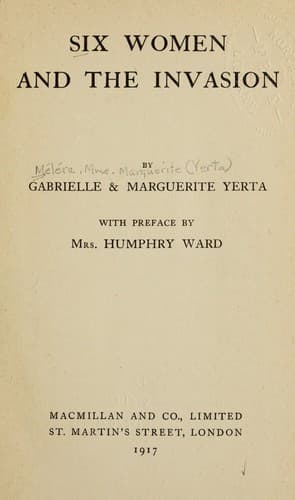
Six Women and the InvasionMéléra, Marguerite-Yerta
History
Six Women and the Invasion
Méléra, Marguerite-Yerta
World War, 1914-1918 -- Personal narratives
The Prussians had forced open most of the houses, and had anticipated
the taxes which they hoped to levy. Fowls, pigeons, geese without
number, and even plump pigs were absent. At Liza's house the ravishers
had shown a certain modesty. A sack of flour, a few pigeons, one or two
ducks only had disappeared. But the intruders had turned the room
topsy-turvy. Did they look for treasure? And, by a sad whim, they had
seized upon two photographs, whose red plush frames were the ornament of
the mantelpiece--Liza in the garb of a nun, and Zidore in a soldier's
uniform. For what purpose had they torn up these precious pictures?
"And Zidore had it taken the first day I saw him!" So the enemy had
destroyed the fond keepsake of a happy day!
Really, the age we lived in was hard, and the Prussians heartless! All
the world was so firmly convinced of this that everybody stayed indoors
as much as possible and ventured reluctantly out of the village, for
fear of dangerous encounters. No one was bold enough to risk horse and
cart on the road, since the first soldier that came might requisition
both. Happy indeed was the owner who was not compelled to turn back and
drive the Prussian to a far-off place. Thus it happened that many a
villager, who, having gone out with team and horse for a few hours,
came back home on foot and alone three or four days later. From this
you may see that communication was not easy, even between places at no
great distance from one another. An old lady, seeing the Germans arrive
in Chevregny, died of the sudden shock, and for several days it was
impossible to send the sad tidings to her son, who was no farther off
than Laon. Indeed, we knew not what was happening in the neighbourhood,
still less at Morny. "The country is overrun with Prussians," we were
told.
So the emotion was great when it was rumoured that flour ran short in
Chevregny, for Chevregny fed two other hamlets and a great many
refugees. Every morning the baker's shop was carried by storm. Every
morning the housewives had to wait their turn for an hour to get a loaf.
It was a heart-rending sight to see how the baker toiled; his wife did
not know which way to turn; his boy knew not what to be at. At this rate
the flour sacks would melt away like snow in an April sun. We had to
find other sacks, or famine would break out in the village. One morning,
then, Liza announced: "My horse is required to go and fetch flour at
Pont-Avers."
In the country the word "requisition" does not exist. You are
"required"--that is all. Mouton, then, was required to go and fetch
provender. Very well. He could not tempt the greed of the Germans, being
well stricken in years, and somewhat lame.
"But who will drive Mouton?" asked Mme. Laroye.
"Well, I don't know, perhaps me," said Liza.
"You don't say so, Liza," her mistress cried out. "There are men enough
left in the village to do that. Now a woman has to stay at home, that is
her right place."
Public-domain text, read in full here on John Shaqi.
Reviews
Reviews
No reviews yet
Be the first to share your thoughts on this work.
Join the Discussion
Join the discussion
Sign in to leave a comment or review.
Sign InorCreate an account