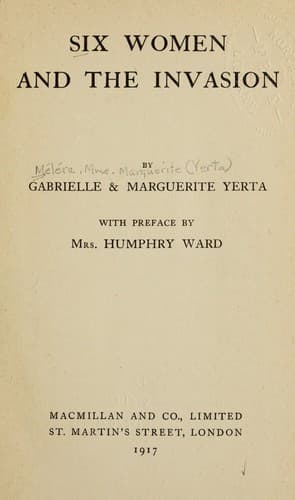
Six Women and the InvasionMéléra, Marguerite-Yerta
History
Six Women and the Invasion
Méléra, Marguerite-Yerta
World War, 1914-1918 -- Personal narratives
The convoy came back that very evening. Our guests of yesterday went
back to their lodging. Only the inhabitants of the "small room" did not
return. Perhaps what was left them of conscience reproached them with
theft.
Early in the morning the carts went off, and after three hours' work old
Tassin declared he had removed all traces of their second visit. The
whole village complained that the rascals had not only dirtied whatever
they approached, but had stolen what they wanted, wasted provender and
oats, and had thrown down whole sheaves of wheat for their horses to lie
on.
In the first weeks of the occupation the invaders bled the country to
death. In Morny they took thousands of fowls, hundreds of pigs and
sheep, and I don't know how many horses and cows. M. Lantois' black
bull, which his ravishers had tethered to a cart, and then abandoned in
the middle of the road, protested in a wild, fierce, and fitful roar
that he repeated every other minute for hours together. The farmers
dreaded marauders still more than official requisitions. For what was
requisitioned they obtained, if they insisted, a note of hand, often
scribbled in pencil and almost illegible, but at least proving they had
been deprived of something. The soldiers of course took an unfair
advantage of their victims, who knew not German, and cheated them in
every way. We were often asked to translate such I.O.U.'s as had been
composed according to the writer's own fancy. "Paid and carried away a
horse," wrote one requisitioner who had but paid with lies.--"Exchanged
two horses of equal worth," another pretended, when a broken-down hack
had supplied the place of a good mare.--"Received 40 lb. of bacon." And
the honest customer knew he had gained 450 kilog. on the pork-butcher.
In spite of all, the country people attached great importance to these
notes of hand, and the marauders gave them none. They went two or three
together, got into the houses when the people were working out in the
fields, searched them from top to bottom, and laid hands on what pleased
them. They stripped the hen-houses and dovecots; they would drop in
unawares when the people were about to sit down to dinner, and then
divert themselves by seizing and feasting upon the dishes before the
balked peasants' very faces. Thus eaten out of house and home, the
village would soon be starved. The Mayor of Morny and M. Lonet resolved
to go to Laon and seek some protection against the raiders. The answer
they got from the Germans was that, first, rural matters were no concern
of theirs, and secondly, that the people were expected to give
everything the soldiers asked for.
A word to the wise is enough.
Public-domain text, read in full here on John Shaqi.
Reviews
Reviews
No reviews yet
Be the first to share your thoughts on this work.
Join the Discussion
Join the discussion
Sign in to leave a comment or review.
Sign InorCreate an account