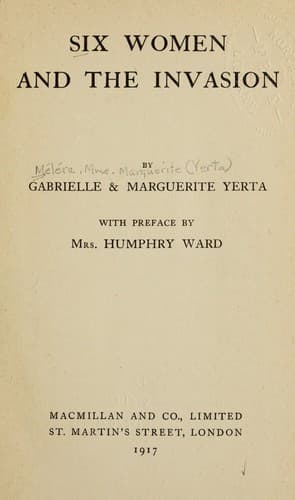
Six Women and the InvasionMéléra, Marguerite-Yerta
History
Six Women and the Invasion
Méléra, Marguerite-Yerta
World War, 1914-1918 -- Personal narratives
O revenge, O sun, you rise, and your first rays make our hearts sing
like the granite of old Egypt. We lived in a fever. War, which
approached, cast its shadow before, but it was a bright shadow, the
shadow of Glory, of more than human courage, of manifold heroism. It was
the pillar of fire which, shielding our hearts from the enemy and the
terrors to come, hid them from our eyes. The passing breath of
enthusiasm quickened the beating of our hearts. As to myself, I put a
good face upon the matter, but all the time I thought with anguish: "It
is war. I shall be alone.... War will sever us from all we love, blood
and tears will be shed everywhere. May God save France, and have pity
upon us!"
On the 2nd of August war was an unquestioned fact: mobilisation was
proclaimed. My husband has served in the Navy, and had to go to
Cherbourg the next day. We then began preparations for the departure of
our sailor, who increased my cares by saying over and over again: "Don't
expect me to remain in the Navy, there is nothing to do there. I will be
sent to the east of France, and see the white of the Prussians' eyes."
The luggage being ready, we went for a stroll in the village. War was of
course the one topic of the day. To qualify them for the toils of Mars,
the men had duly sacrificed to Bacchus, and their patriotism was none
the less fiery for that. Most women were silent. Many had cried their
eyes quite red. One day more, and they would be alone with groups of
small children. A very young woman, almost a girl, declared with a toss
of her light hair: "Bachelors who have but their own body to care for
ought to go and fight, that's right, but fathers of a family!..." Her
neighbour next door, Mme. Turgau, nodded assent. She had a baby in her
arms, and was pensively listening to her husband who, hot with anger,
was speechifying not very far off. In his quality of orator, he
discoursed not only upon Germans, but upon spies also. In the morning
two Germans had been arrested in Laon, and the day before a man who was
going to blow up a bridge had been shot. But look! Two strangers
appeared at the corner of the street. All faces grew serious, and
Turgau, advancing towards the men, demanded their papers. When they
refused to show them, the crowd grew nervous, and Turgau thought himself
insulted. Cries and bad names filled the air, until the soldiers,
astonished at the uproar, took the culprits away to examine their
papers.
The lover of justice came back home greatly pleased with himself. People
gathered round him, and declared: "Policemen, gendarmes, all humbug!
Fortunately we are here to maintain order." And all together they went
to the next inn, and from the adventure drew this moral lesson: No more
strangers, France for Frenchmen!
Public-domain text, read in full here on John Shaqi.
Reviews
Reviews
No reviews yet
Be the first to share your thoughts on this work.
Join the Discussion
Join the discussion
Sign in to leave a comment or review.
Sign InorCreate an account