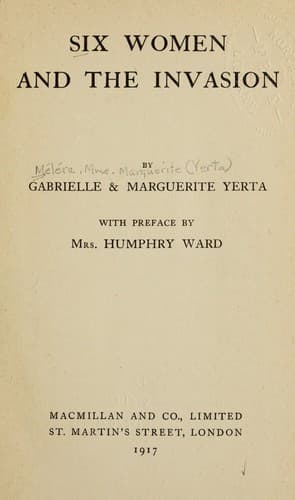
Six Women and the InvasionMéléra, Marguerite-Yerta
History
Six Women and the Invasion
Méléra, Marguerite-Yerta
World War, 1914-1918 -- Personal narratives
A number of _Simplicissimus_ completed our edification. The proud
German Michael was represented spitting his seven foes on his mighty
sword. The Cossacks, bullying women and children, turn up the whites of
their eyes at the sight of a single Uhlan, and fall on their knees. In
Lorraine the German soldiers, by way of a change, leave off firing at
the French: "Let us keep a few of them to kill with bayonets," they say.
In conclusion, an Englishman helps his little Japanese monkey up the
noble oak-tree where the German eagle is perched: "Go on," he says, "try
to pluck some feathers from his tail."
CHAPTER VIII
The literature of the day, then, gave us little comfort. And every week
the _Journal de Guerre_ played the very same tune. Yet about the end of
November we read in its columns a proclamation from the General-Governor
of the place, which every one was bound to acknowledge interesting, if
not agreeable. This proclamation brought us the orders and prohibitions
of the almighty authorities.
"It is expressly forbidden to give assistance and shelter to French or
Allied soldiers. Owners of arms of all kinds, telegraphic and telephonic
apparatus, and bicycles, are ordered to bring them to the military
authorities.
"It is expressly forbidden to keep live pigeons of any breed.
"It is expressly forbidden to go without passport from one place to
another."
The tyrant who issued the orders concluded with these words:
"The population have nothing to dread as long as they submit to the laws
of war and comply with our orders."
With our orders! With this you may go far, and they went very far.
The general regulations did not concern us nearly. Unfortunately we
never met wounded or straggling French soldiers; we possessed neither
bicycles nor telephonic or telegraphic apparatus; we owned no pigeons
whatever, and we were content to assure our neighbours of our sympathy,
when, not without groanings and great sorrow, they slaughtered the
inhabitants of their dovecots. This massacre aimed at the suppression of
all carrier-pigeons, and in many farms the application had not waited
for the law. At Mme. Lantois', for instance, an under-officer and two
men had dropped in unawares, strangled and taken away as many pigeons as
they were able to carry.
"Don't take the big white ones," besought the farmer's wife.
Naturally, the Germans are too wise not to be suspicious; those French
people might be cunning enough to disguise their carriers as big white
feather-legged pigeons.
One night, old Leprince heard a noise in his out-house. Half undressed,
he hastened out, and met face to face four soldiers, who in broken but
energetic language ordered him back to his mattress. The old man watched
the intruders go away, went to his dovecot, and by the light of his
lantern saw the floor bespattered with blood and scattered all over with
pigeons' heads.
Public-domain text, read in full here on John Shaqi.
Reviews
Reviews
No reviews yet
Be the first to share your thoughts on this work.
Elsewhere in the archive
Join the Discussion
Join the discussion
Sign in to leave a comment or review.
Sign InorCreate an account