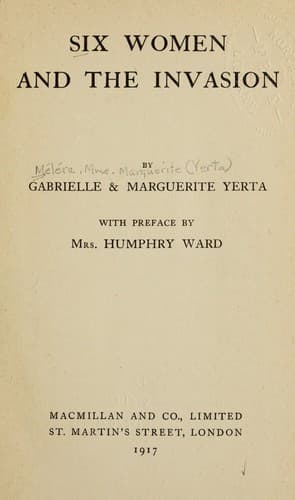
Six Women and the InvasionMéléra, Marguerite-Yerta
History
Six Women and the Invasion
Méléra, Marguerite-Yerta
World War, 1914-1918 -- Personal narratives
The first number of this precious periodical was a real poem. It was
addressed to "the high and chivalrous sentiments of the true French
nation." Its authors did not despair of explaining to the French nation
that its Government and its Allies had shamefully deceived it, and hoped
that it would soon see who was really responsible for the war, what
humane and disinterested part Germany had borne in the whole affair. In
another article peace was openly hinted at, and the author set forth the
advantages which France would get if she listened to reason, that is, if
she abandoned the Allies and sided with gentle Germany. And then,
forgetful of all reserve, the Germans added that, in case of peace, the
Government, far from requiring a contribution of war, would probably be
inclined to "build a bridge of gold to France"--what a good promise we
had there!--as Bismarck did in '66 to Austria. "It seemed weakness," the
profound politician added; "it was strength." If the learned members of
the German Universities had but attended a common school in France, they
would have learned that which our La Fontaine wrote: "If we force our
talent, we shall do nothing with grace." Maybe they had understood that
sweet manners are not congenial to their nature, that the voice of the
cannon alone suits their temper. We should not see them propose to
France with bows and smiles the fate of vassal that Austria had
accepted in '66. On the second page, the _Journal de Guerre_ magnified
the capture of Antwerp, and described its consequences in pompous
phrases. Then the author of a small and acid article concerning the
relations of France and Russia concluded with this sentence, as witty as
it is nicely turned:
"Varus, Varus, give me back my millions and my billions! If Russia
listens to that! It is very doubtful!" This is a literal translation.
Indeed, we laughed. Not a Homeric laugh, of course, stifled laughter
maybe, a tittering rather than a hearty laugh, a catching laugh which
the enemy might have happened to overhear, a real laugh all the same. We
should have felt doubly prisoners if we had not made fun of our jailers,
and to be prisoners only once was quite sufficient.
As we knew German, we fell upon the papers we came across and bitterly
enjoyed the high praises they bestowed on their high deeds. They
pleasantly jeered at the "parti-coloured army" of the Allies, at the
negroes who, according to them, "tremble with cold like a leaf tossed by
the wind," which, the Prussian libellers added, must produce a bad
effect in a battle.
Public-domain text, read in full here on John Shaqi.
Reviews
Reviews
No reviews yet
Be the first to share your thoughts on this work.
Elsewhere in the archive
Join the Discussion
Join the discussion
Sign in to leave a comment or review.
Sign InorCreate an account