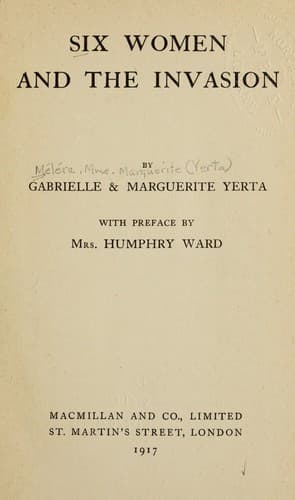
Six Women and the InvasionMéléra, Marguerite-Yerta
History
Six Women and the Invasion
Méléra, Marguerite-Yerta
World War, 1914-1918 -- Personal narratives
We thought ourselves crushed with grief. What seemed to us most
unbearable was the want of news. Every family had one or several of its
members away at the front, and we asked over and over again, are they
dead, wounded, ill?
And we knew no more of what happened in the invaded country, in Lille,
St. Quentin, or Rethel, than of what happened in San Francisco, Paris,
or Pekin. Every village was an island carefully isolated from the rest
of the world, and kept up very few relations with the nearest towns. On
the other hand, we can think only with compassion of the everlasting
threats hanging over our heads, of the uninterrupted plunder, of the
vexatious measures, which left us no rest. Yet all this was bearable
compared with what we had still to support! First the bad season was
coming; soon we should suffer from the cold, since fuel was rare; and
even from hunger, since bread was scarce. One day Colette cried out:
"Oh, mother, look! Winter is coming; the Christmas roses are in bloom."
On the very same day we heard that the village had a new commandant.
Until then Morny had given hospitality but to convoys and troops of the
reserve. We should now have to deal with soldiers on active service.
About a hundred Death's Head Hussars settled themselves in the big farm
on the Laon road, and their lieutenant became the supreme chief of the
commune. The invaders certainly organised their government. Every
village was provided with a commandant, who grew more and more powerful.
You can imagine how these people were puffed up with pride. Just think
of a lieutenant, a small country squire, owning beneath the sky of
Pomerania three acres of barren, unfruitful land, who all of a sudden
sees himself absolute master of a rich territory of 1500 souls. It was
enough to turn his head. Von Bernhausen was the name of the one we got.
He was of an historical family, and gave himself out to be a rich
cattle-breeder. He was a huge fellow--Geneviève and I reached to his
waist--aged about twenty-six. Boldly cleft from heels to chin, he bore
on his interminable legs a kind of shortened bust, a gallows head with
small eyes, a little nose, still less forehead, a great deal of cheek,
and still more of a thick-lipped and ever damp mouth. This ugly
lieutenant was a thorough glutton, and the poultry-yards of Morny had
many proofs of it. As he did not walk very upright, his coat, which was
always greasy, formed in front a mass of horizontal creases that might
have aroused the jealousy of an accordion. Two days after his arrival he
was nicknamed Bouillot for short, a diminutive of Crabouillot, which
means in the _patois_ "dirty." Self-confident, conscious of the rights
his title and name gave him, this lordly personage went to Laon, or
received his superiors, without any change for the better in his dress.
The peasants said he was the cousin of the Emperor. We shall be more
modest, and be content with saying that his forefathers are very well
known in Germany and other countries.
Public-domain text, read in full here on John Shaqi.
Reviews
Reviews
No reviews yet
Be the first to share your thoughts on this work.
Elsewhere in the archive
Join the Discussion
Join the discussion
Sign in to leave a comment or review.
Sign InorCreate an account