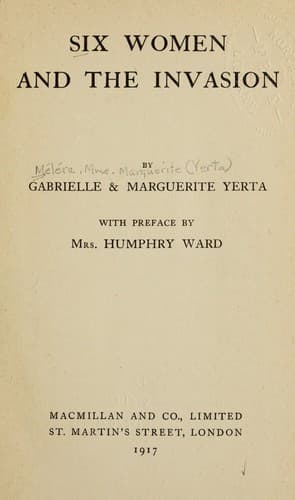
Six Women and the InvasionMéléra, Marguerite-Yerta
History
Six Women and the Invasion
Méléra, Marguerite-Yerta
World War, 1914-1918 -- Personal narratives
His faults were overlooked in high
quarters, and I leave you to imagine the benefit he reaped from his post
and the way he understood comfort, good cheer, and service. To begin
with, he requisitioned a capital cook of the place, and told her that
she was to exert all her skill on behalf of Germany. A salary was quite
out of the question. Early in the morning he was often to be seen in a
poultry-yard, busy selecting his birds among the few geese, ducks, and
fowls that were still there, and then: "I want this to be at the farm at
ten o'clock." If the owner timidly asked for a note of hand, the officer
turned short round and shouted in his face: "I told you to bring me this
at ten o'clock."
Once he came to M. Lantois and said: "I want the carriage you've got;
bring it to me." The farmer, after a moment's hesitation, dared to
pronounce, too, the words "note of hand."
"I shall give none; you don't want any; your cart won't get lost."
Suddenly the man went into a regular rage, tore up and down the yard,
uttered yells of anger, and bellowed:
"I am the commandant of this village! I can do everything I please! You
must give me all that I want!"
He took the carriage away, and two days later it was lying broken in a
ditch.
Thus we had nothing to do but suffer these exactions. We had marched
straight back towards the Middle Ages. We were bondsmen, attached to the
soil, as no one was allowed to leave the land. The mighty and powerful
lords had re-established all feudal rights. They took toll for the
shortest journeys, sold our own flour in common mills, from all men
required villein service. They were careful not to forget certain
prerogatives, and thought they had a double right to the favour of all
women and girls, being at once lords and conquerors. Accordingly a house
like ours seemed to them especially created for the pleasure of the King
of Prussia's officers.
And yet how careful we were to hide ourselves! From the moment that the
hussars haunted the country, Mme. Valaine did not allow us even to go
and fetch the bread. The bakehouse was deemed too far off, and the
garden sufficient for exercise. Mme. Lantois' farm, M. Lonet's house, a
hundred yards to the right, a hundred yards to the left, were the
longest walks we were permitted to enjoy. And before risking our nose in
the street we took a rapid survey.
"No Prussian is to be seen? Good, I will risk it."
Despite these precautions, we were forced to receive frequent
requisitioners or perquisitioners, and we soon heard that the soldiers
called our habitation "the house of the pretty girls."
Public-domain text, read in full here on John Shaqi.
Reviews
Reviews
No reviews yet
Be the first to share your thoughts on this work.
Elsewhere in the archive
Join the Discussion
Join the discussion
Sign in to leave a comment or review.
Sign InorCreate an account