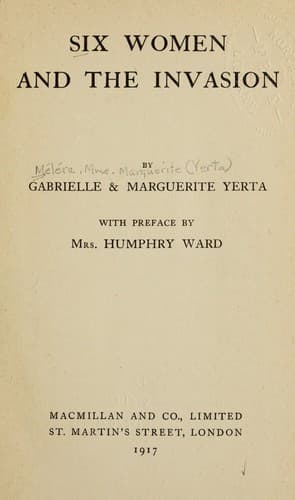
Six Women and the InvasionMéléra, Marguerite-Yerta
History
Six Women and the Invasion
Méléra, Marguerite-Yerta
World War, 1914-1918 -- Personal narratives
The Captain came first alone, and the day after with two Surgeon-Majors.
They made calculations, and then declared that we might receive thirty
soldiers. Two empty houses our neighbours offered out of kindness would
contain twenty other beds. Fifty soldiers would compose quite a
sufficient ambulance, and to our heart's delight we might devote our
strength to the wounded.
"In Laon, they will be only too pleased to send you convalescents," M.
Vinchamps told us; "plenty of patients will soon fill the hospitals; and
a doctor from the town will come every day to tend your invalids."
This medical visit did not remain the only one M. Vinchamps paid us.
About nine o'clock, his day's work over, our new friend came round and
knocked at the window. Our talk was chiefly on war, the only topic we
took an interest in.
"Men are good for nothing," M. Vinchamps said; "courage is their only
gift. That is why I am delighted with the present war. At peace, men are
out of their right element."
"Then you must improve the occasion, and make the best of it, for
certainly there will be universal peace after the present war, and you
men will be for ever out of your element."
No one answered, and our silence called up a picture of dead and wounded
stretched upon a plain where a battle had taken place. And again we
talked of Belgian courage, of that heroic Liége which had to face such
fearful odds, and did not yield to brute strength. We likened the
storming party to the turbulent waters which beat furiously against a
dyke. But we knew the dyke was strong, and would not give way.
The Germans were not highly appreciated by Captain Vinchamps.
"They are not intelligent," he declared.
"But----"
"They are not. I do not deny their qualities. They are fine imitators,
but no creators. They make good use of others' inventions, and derive
benefit from discoveries they would be unable to make themselves. Their
talents--quite practical--are not what is called intelligence. Cuvier,
Pasteur, Lamarck have no rivals on the other side of the Rhine, and
their work no equal. Besides, consider that for fifty years our
neighbours have thought of but one goal: a victorious war."
"But that is very important just now."
"Never mind. Intelligence will get the better of brute strength and
crush it."
The mere thought of victory sent a thrill of rapturous joy through our
hearts.
On going out through the yard, lit up by the moon's rays, the Captain
listened to the whistle of the trains, and said with a smile:
"Food for powder!"
At full speed the trains rolled on both lines day and night; the food
for powder went by without ceasing.
Food for powder!
And yet the expression is not right. For the soul of every man was
awake. At the call of war all men were ready to fight and to die; all
shouted "victory," in the assurance that it would come to us.
In the village our confidence met some distrust. Mme. Tassin, who acts
as housekeeper when we are away, tossed her grey head.
Public-domain text, read in full here on John Shaqi.
Reviews
Reviews
No reviews yet
Be the first to share your thoughts on this work.
Join the Discussion
Join the discussion
Sign in to leave a comment or review.
Sign InorCreate an account