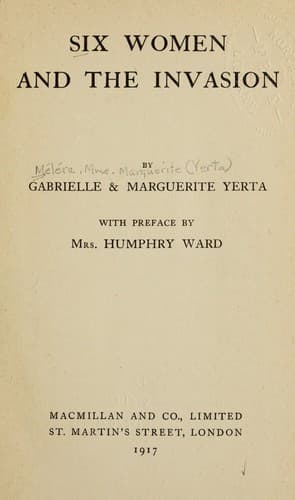
Six Women and the InvasionMéléra, Marguerite-Yerta
History
Six Women and the Invasion
Méléra, Marguerite-Yerta
World War, 1914-1918 -- Personal narratives
But these few windfalls did not make up for the lack of many things,
hitherto looked upon as indispensable. And what was our alarm on hearing
once that bread itself would run short! On a certain Saturday the people
who went to fetch flour came back with their carts empty; likewise the
following week. No more bread! This bad fortune had been long foreseen,
and to provide against it we had dried slices of bread in the oven, and
thus filled many and many a tin. But seven persons are not long eating
up a reserve of this kind. So by a recipe, which all the village knew, a
dough was made of mashed potatoes and a little flour--every one had
managed to lay by a few pounds of it--and these thin cakes, baked in the
oven, bore some likeness to the food we missed.
Other villages were even less fortunate than ours, and had no bread at
all--officially at least--for a very long time. The farmers who had
contrived to hide corn had to grind it in a coffee-mill or with the help
of a mincing-machine, and the ovens--long unemployed--were again turned
to account when no Germans were present.
On the whole our village did not starve now, as it had starved during
October and November. A few peasants had mysteriously dug up their
potatoes, and sold them just as mysteriously. Besides, through the
Mayor's clever management, the Germans consented to our buying from them
a certain quantity of rice, salt, and sugar. These goods, we heard, were
the remainder of provisions sent to the commissary of stores. They were
sold on stated days, and every inhabitant was entitled to a kilo of
rice, a pound of sugar, half a pound of salt, once a fortnight. It was a
sheer pleasure to chaffer with the invaders; they demanded gold as
payment for their scanty revictualling, but later on they had to content
themselves with a sum partly in gold, partly in silver. They played
hang-dog tricks on the middlemen. Once the Mayor was informed that such
and such goods were to be had to the amount of three hundred francs.
Greatly pleased, he paid in golden cash. He was kept waiting one hour,
then two, then three. At length he was told that he had been deceived.
The provisions were not nearly so abundant as they were first thought;
there was scarcely a hundred francs' worth. The difference was to be
given back to the purchaser. And, indeed, two hundred francs were
returned to him, but the two hundred francs were paid in German notes!
Public-domain text, read in full here on John Shaqi.
Reviews
Reviews
No reviews yet
Be the first to share your thoughts on this work.
Elsewhere in the archive
Join the Discussion
Join the discussion
Sign in to leave a comment or review.
Sign InorCreate an account