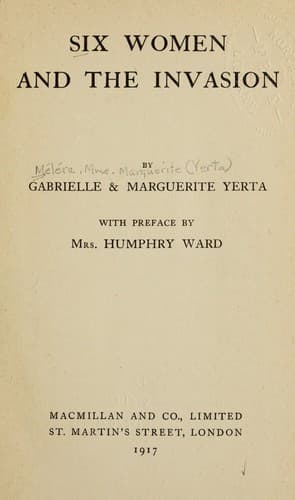
Six Women and the InvasionMéléra, Marguerite-Yerta
History
Six Women and the Invasion
Méléra, Marguerite-Yerta
World War, 1914-1918 -- Personal narratives
For three weeks we had no bread at all; then the Germans vouchsafed us
flour of their own, so much a day; a loaf made with this powder took the
shape of a small, flat, brown and heavy crown, which gave us such acute
pains that we often preferred being hungry to having our fill of this
dough. We were all poor wretches and starvelings, but we were
fellow-citizens, and we arranged to keep a certain level of the
provisions. But a hundred times more wretched and starving were the
refugees who, when their villages were burned to the ground, had been
shared among the communes throughout the country. For months they had
neither house nor home, and about forty of them had taken shelter in
Morny, where they were huddled in one or two empty houses, lived but
scantily, and slept on straw. Several died during the winter. Laon was
also overrun with hundreds of those poor fugitives, and throughout the
town you were assailed and pursued by small ragged beggars who made you
think of Naples or Marseilles. The poor things moved your pity the more
deeply as you were compelled to think:
"Such is perhaps the fate that is awaiting me."
Indeed, nobody was sure that a whim of the Germans would not turn him
out of doors. It was seen more than once. So many things were
requisitioned. First of all, the invaders laid the absent people under
contribution, and as long as their houses had window-panes and
furniture, they were sufficient for the plunderers. But afterwards? A
large manufacturer of the neighbourhood, M. Vergniaud, had built a
castle a few years before in the Renaissance style, and filled it with
Renaissance furniture. When the rumour of invasion came, the owner took
flight with his household. The first soldiers quartered in the villa
knocked off the sculptures of the cupboards with axes, while others
carried away what pleased them. We saw a china bath taken away to the
trenches; it contained two small pigs. In the luggage of an officer who
lodged in our house there were damask curtains, plates of old Strasburg
ware, and even children's clothes, all of which came from that castle.
In the end what remained of the furniture was taken to the station,
loaded upon railway trucks, conveyed from one place to another for a
fortnight, and then sent to an unknown destination. To Germany or to the
trenches?
Some officers, who lived in Laon, did not approve of the costly
furniture about them, so they sent for three civil prisoners. The orders
they gave them were simple: "Take the furniture into the garden and
break the whole in pieces with your axes; it will serve as firewood."
The house thus cleared, these gentlemen had but to look elsewhere for
the wherewithal to furnish their rooms.
Public-domain text, read in full here on John Shaqi.
Reviews
Reviews
No reviews yet
Be the first to share your thoughts on this work.
Elsewhere in the archive
Join the Discussion
Join the discussion
Sign in to leave a comment or review.
Sign InorCreate an account