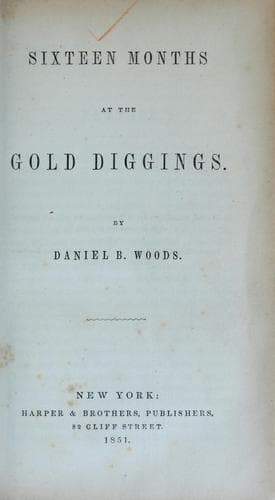
Sixteen months at the gold diggingsWoods, Daniel B.
History
Sixteen months at the gold diggings
Woods, Daniel B.
California -- Description and travel; California -- Gold discoveries; Frontier and pioneer life -- California
The furnishing of such a company as ours with all the horses and mules
necessary for a journey of about eight hundred miles was not to be
accomplished at once. On the morning of the 8th of March, and the
fifteenth day after our arrival, we were mounted on “mustangs,” a small
and hardy horse, peculiarly adapted to the mountains over which we were
to travel, our provisions and clothing being on the backs of mules. All
being ready, we slowly filed out from the hacienda of Mr. Laffler, a
large farmer from Ohio, who was under contract to supply us with animals
to Mazatlan. We had spent some days here preparing for the march, and
amusing ourselves in spearing fish, and in shooting deer and alligators,
being ourselves likewise the sport of innumerable swarms of musquitoes,
ticks, fleas, and jiggers. This latter insect, though very small, is the
occasion, at times, of great inconvenience and suffering. These tropical
insects handled us so cruelly, that we were compelled to write, eat, and
sleep with gloves. To avoid them at night, I encased myself in a bag,
made of cotton, which I drew up over my whole body, then bringing it
around my head. This arrangement proved so much to my advantage that I
continued it during the whole time of my absence.
Upon the march, a _Caballero_, mounted upon his mule, took the lead,
followed by the whole train of draught mules and the attendants. Then
came the guide and the company, sometimes drawn up, under our military
captain, in regular order of march, and sometimes extended out over the
trail as far as the eye could reach. We were advised to keep well
together, and never to dispense with the night-guard, on account of the
guerillas, who would ever be on the watch for an opportunity to attack
us.
For several days our march lay across the level plains of the Tierra
Caliente, the region of perpetual spring, and clothed with verdure.
Having reached the foot-hills of the Sierra Madre, or Andes of Mexico,
one day’s travel brought us up into the temperate region. This was the
lower table-land. The landscape was no longer gay with flowers, but
abounded in immense forests. Here were found the varieties of the
musquite, the stately cypress, and the banyan. The whole undergrowth was
a thorny thicket, in which the prickly pear and the cactus predominated.
After traveling a day over this region, we came to a valley, into which
we descended, and where, in the midst of a fertile country, we entered
Villa de Vallee. This town contains a cathedral in ruins, which, like
those of many of the towns of Mexico, were partially destroyed at the
time of the revolution, and have never since been repaired. One of the
wings was occupied as a chapel, while the residence of the _Padre_ was
in a kind of shed behind.
Public-domain text, read in full here on John Shaqi.
Reviews
Reviews
No reviews yet
Be the first to share your thoughts on this work.
Join the Discussion
Join the discussion
Sign in to leave a comment or review.
Sign InorCreate an account