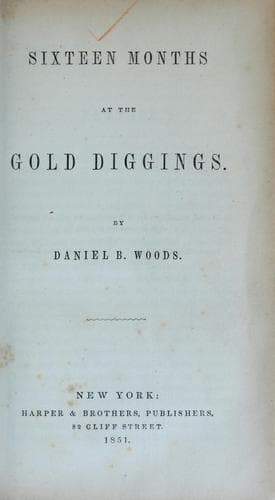
Sixteen months at the gold diggingsWoods, Daniel B.
History
Sixteen months at the gold diggings
Woods, Daniel B.
California -- Description and travel; California -- Gold discoveries; Frontier and pioneer life -- California
A uniform and reliable currency being a national benefit, our
government regards the support of the Mint establishment as
properly a national expense. Any person may bring his bullion to
the Mint, and have it converted into coin without charge. Many
well-informed persons suppose that all the coinage of the Mint is
for government account. On the contrary, the bullion is all
deposited by individuals, and is coined for them. Government simply
receives the bullion, ascertains its value, converts it all to a
uniform standard, shapes it into coins, and puts a stamp upon it
that shall give assurance of its value. From the coins thus made,
each depositor is paid the exact value of his bullion.
The term _bullion_, as used at the Mint, includes all gold and
silver, whether in the shape of bars, lumps, grains, plate, or
foreign coins. All these varieties of bullion are received at the
Mint for coinage, but no deposit is received of less value than one
hundred dollars.
The _weights_ used at the Mint are Troy weights, and they are
always expressed in ounces and decimals of an ounce. Thus, 18 oz.
15 dwt. is written 18·15 oz.
The _fineness_ of bullion is expressed in thousandths. The standard
of our coins, as fixed by law, is 900 thousandths; that is, in 1000
ounces of coin, 900 ounces must be pure metal, and 100 alloy. The
fineness of deposits is similarly expressed. Thus, 860 thousandths
fine signifies that of a given weight (of gold, for instance) 860
thousandth parts are pure gold, and the remainder (140 thousandths)
some other metal.
When bullion is left at the Mint for coinage, a receipt is given to
the depositor, bearing the date and number of the deposit as
entered in the weigh-book, and made payable to him or his order.
In this receipt, of course, only the weight of the bullion before
melting can be stated; its value depends upon its weight after
melting, and its fineness, which is to be subsequently determined
by assay.
Each deposit is separately assayed and reported upon by the
assayer. Its value is then calculated, and a detailed memorandum
prepared, exhibiting the number, date, depositor’s name, kind of
bullion, weights before and after melting, fineness, silver parted
(if the deposit is gold), value of the gold, value of silver
parted, deductions, and net value payable to the depositor. This
memorandum is given to the depositor with his coin. Deposits are
assayed, calculated, and ready for payment generally within a week
after they are made; and they are paid on the surrender of the
original Mint receipt.
Public-domain text, read in full here on John Shaqi.
Reviews
Reviews
No reviews yet
Be the first to share your thoughts on this work.
Elsewhere in the archive
Join the Discussion
Join the discussion
Sign in to leave a comment or review.
Sign InorCreate an account