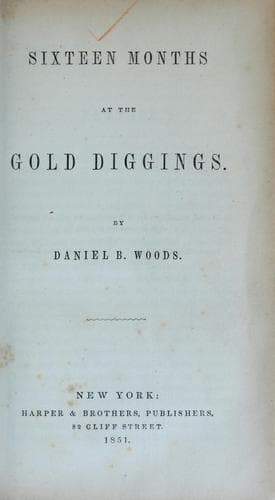
Sixteen months at the gold diggingsWoods, Daniel B.
History
Sixteen months at the gold diggings
Woods, Daniel B.
California -- Description and travel; California -- Gold discoveries; Frontier and pioneer life -- California
I have said that the Mint makes no charge for converting bullion
into coin. This is strictly true; but, inasmuch as depositors will
frequently find by their “memorandums” that certain deductions have
been made by the Mint from the proceeds of their bullion, some
farther explanations are required. A miller who should grind wheat
and corn without taking _toll_, would be correctly said to grind
without charge. And if a farmer should carry his wheat in the
sheaf, or his corn in the ear, or corn and wheat mixed together in
the same bag, he would hardly object to pay the miller for
thrashing, shelling, or separating. If a depositor brings to the
Mint bullion “fit for coinage,” that is, of standard fineness and
properly alloyed, he will receive in return an equal weight of
coins, without charge or deduction of any kind. If, however, his
bullion requires _refining_, _alloying_, _toughening_, or
_separating_, to make it “fit for coinage,” this preliminary
expense, carefully determined by experience, is deducted from the
proceeds of the deposit.
The discovery of the California mines has suddenly increased the
deposits at the Mint from five or six millions of dollars annually
to thirty or forty millions. The whole amount received at the Mint
and branches, from December, 1848, to this date, is about sixty-six
millions of dollars. Of this, about twenty-four millions belong to
the present year.
The fineness of California gold ranges from about 825 to 950
thousandths. The bulk of them, however, are between 870 and 900,
the average being about 884. At this fineness, if entirely free
from dirt, an ounce of gold, with the silver contained (deducting
Mint charges), is $18 34. There is usually present in California
gold a portion of dirt, averaging five or six per cent. of the
weight. Five per cent. of dirt would reduce the average value given
above to $17 42.
The gold of California contains usually about eleven per cent. of
silver. This silver is separated for the benefit of the depositor,
when the amount contained in the deposit is sufficiently large to
pay the expense of separating, and yield a surplus of at least five
dollars. If the surplus is less than this, the depositor receives
no benefit from it, the law requiring that it shall accrue to the
Mint, and be used for paying ordinary expenses. It is therefore for
the interest of depositors to make their deposits sufficiently
large to secure the silver contained. At the average fineness of
884, this would require from 75 to 80 ounces.
Public-domain text, read in full here on John Shaqi.
Reviews
Reviews
No reviews yet
Be the first to share your thoughts on this work.
Elsewhere in the archive
Join the Discussion
Join the discussion
Sign in to leave a comment or review.
Sign InorCreate an account