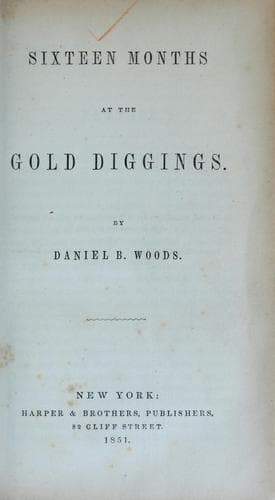
Sixteen months at the gold diggingsWoods, Daniel B.
History
Sixteen months at the gold diggings
Woods, Daniel B.
California -- Description and travel; California -- Gold discoveries; Frontier and pioneer life -- California
July 6th. We have to-day removed to the opposite side of the river.
This, with pitching our tent, has occupied most of the day. Still, we
have made $4 each. I have been seated for several hours by the river
side, rocking a heavy cradle filled with dirt and stones. The working of
a cradle requires from three to five persons, according to the character
of the diggings. If there is much of the auriferous dirt, and it is
easily obtained, three are sufficient; but if there is little soil, and
this found in crevices, so as only to be obtained with the knife, five
or more can be employed in keeping the cradle in operation. One of these
gives his whole attention to working the cradle, and another takes the
dirt to be washed, in pans or buckets, from the hole to the cradle,
while one or two others supply the buckets. The cradle, so called from
its general resemblance to that article of furniture, has two rockers,
which move easily back and forth in two grooves of a frame, which is
laid down firmly on the edge of or over the water, so that the person
working it may at the same time dip up the water. It must be inclined a
few degrees forward, that the dirt may be washed gradually out, and must
be so placed that the mud may be carried off with the stream. Cleets are
nailed across the bottom of the body, over which the loose dirt passes
with the water, and behind which the magnetic sand and gold settle. An
apron is placed beneath the hopper, and conducts the water, dirt, &c.,
from that to the body below--a construction similar to that of the
common fanning-mill. The hopper, which is placed at the top of the
cradle behind, is a box, the bottom of which is a sheet of tin, zinc, or
sheet iron, perforated with holes from the size of a gold dollar up to
that of a quarter eagle. Through these the dirt, gravel, and gold are
all carried by the water upon the apron and into the body below, leaving
only the pebbles, too large to be passed through, in the hopper, which
are thrown out by raising it in the hands, and by a sudden forward, then
backward motion, depositing them on one side in a heap. To facilitate
this operation, the hopper is sometimes made with hinges, by which
means, by the raising the forward end, the dirt falls over behind. There
is generally a handle, so placed on one side that the cradle may be
rocked with the left hand, leaving it to the choice of the person
rocking whether to stand or sit while at work. The dirt taken from the
hole is turned into the hopper at the top. The person, rocking the
cradle with his left hand, at the same time uses his right in dipping up
continually ladles of water, which he dashes upon the dirt in the
hopper. Twenty-five buckets of dirt are generally washed through, the
mass in the body of the cradle being occasionally stirred up to prevent
its hardening, and thus causing the gold to slide over it and be lost.
It is then drawn off into a pan through holes at the bottom of the
Public-domain text, read in full here on John Shaqi.
Reviews
Reviews
No reviews yet
Be the first to share your thoughts on this work.
Join the Discussion
Join the discussion
Sign in to leave a comment or review.
Sign InorCreate an account