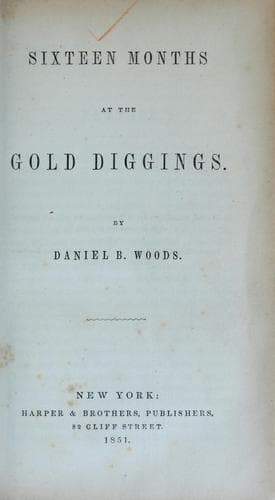
Sixteen months at the gold diggingsWoods, Daniel B.
History
Sixteen months at the gold diggings
Woods, Daniel B.
California -- Description and travel; California -- Gold discoveries; Frontier and pioneer life -- California
Though the broad belt of ground which has been here described is named
the gold region, it is by no means to be supposed that the precious
metal is found equally distributed over its surface, as if it had
rained down, or been thrown broadcast by some volcanic action over the
whole country. The placers where the auriferous dust is found are, in
comparison with the whole extent of the country so named, exceedingly
limited. The miner often travels many miles over this region--he wanders
for days along its river banks and over its bars, and turns aside into
some of its numerous ravines--he often pauses to examine spots which
appear to him favorable, and with his pick, shovel, and knife--always
his companions--digs his fifty holes, testing each with his pan, without
success. And even when he comes to the favored bar or placer from which
many pounds of gold may have been taken, there is perhaps one chance in
fifty in favor of his collecting any considerable amount of gold. Upon
these very localities thousands of industrious miners barely make their
living. The hopeful miner eagerly hastens, with high expectations, to
the diggings. He chooses his bar, and marks off a claim; this he
faithfully “prospects,” then abandons it for another and another, till
he comes to the conclusion that the whole business is a lottery.
The primitive formations prevailing through the gold diggings are the
soft granite and the talcose slate. The superstrata are various, and
depend upon the formations in the hills adjoining. The first in
importance, as being intimately combined with the gold, is the quartz.
This is found in broken fragments, from the fine pebbles to the huge
masses, over the whole surface of the country. It is often seen crowning
the hill-tops, and sometimes is found in veins in the valleys. There
can be no doubt that the quartz and the gold were formed in combination.
This is now so universally admitted as not to require to be
substantiated. It is also placed beyond a doubt that the gold of the
mines has been attrited, and taken to the various deposits by the action
of water; and the gold is found in coarser or finer particles, according
as it is exposed to a greater or less degree of this action. In some
cases, the gold has been found running in veins, more or less rich,
through the quartz, and so closely combined that they must be reduced to
powder before they can be separated. With but few exceptions, however,
the working of these veins has not proved profitable.
Public-domain text, read in full here on John Shaqi.
Reviews
Reviews
No reviews yet
Be the first to share your thoughts on this work.
Join the Discussion
Join the discussion
Sign in to leave a comment or review.
Sign InorCreate an account