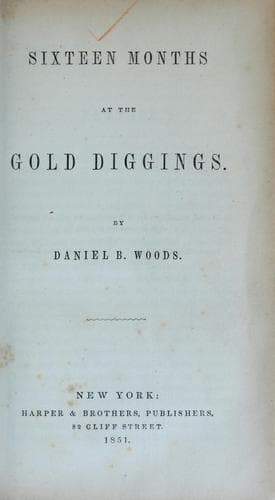
Sixteen months at the gold diggingsWoods, Daniel B.
History
Sixteen months at the gold diggings
Woods, Daniel B.
California -- Description and travel; California -- Gold discoveries; Frontier and pioneer life -- California
In the spring of the year 1848, Mr. Sutter employed two men to make an
exploring tour along the branches of the American River, where it passes
through the foot-hills already described, to find a growth of pine
timber, and a suitable site for a mill for sawing it into boards. The
site and the timber were found upon the south branch of that river.
Little dreamed those day-laborers, as they broke ground for their rude
mill, in that solitary wilderness, that the results of that day’s labor
would give employment to thousands and tens of thousands of such
implements as they then used; that the one spadeful of red dirt, at
which they gazed so intently, at the bottom of which a few yellow bits
of shining dust appeared, was soon to exert a mysterious, a profound
influence upon the commerce, the welfare, the destinies of the whole
human family. An influence was about to go forth from that narrow ditch
which would return again, and bring with it an innumerable multitude,
thronging from every quarter of the world, overcoming all difficulties,
bringing with them their houses and supplies, and spreading themselves
over the hills and valleys of this country. That moment was an epoch in
the world’s history. It was the discovery of GOLD; and, which is of far
more importance, it was the _planting of the_ ANGLO-SAXON _upon the
shores of the Pacific_.
At this time California contained but fifteen thousand people. The belt
of gold country was comparatively uninhabited, and entirely without
supplies of provisions, except such as might be procured by the rifle of
the hunter, and as entirely destitute of shelter. In a few weeks after
the 1st of June, 1848, it is estimated that there were five thousand
miners. As they came generally without provisions, these commanded an
exorbitant price. At the time Rev. Alcalde Colton visited the mines,
which was some time after the discovery, flour sold for $4 the pound,
sugar and coffee at $4, a tin pan $6, laudanum $1 the drop, rum $20 a
quart, and picks sold at $18 each. It was not until the summer and fall
of 1849 that the American emigration began to arrive. They came across
the plains, through Mexico, by the Isthmus, and around the Horn; and
before the winter it was calculated that there were fifty thousand
engaged in this business. During this season the miners extended
themselves along many of the streams and through many of the ravines of
the gold region. The provisions were scanty and unsuitable. Very few
vegetables, and little fresh meat, were to be purchased at any price.
Flour and pork were the staples, which were sold at $1 the pound till
the rainy season commenced, when they sold for $2. A few bottles of
pickles which reached the mines were sold at $6 and $8 the bottle. In
the winter good boots brought $96, and ordinary $32 and $64.
Public-domain text, read in full here on John Shaqi.
Reviews
Reviews
No reviews yet
Be the first to share your thoughts on this work.
Join the Discussion
Join the discussion
Sign in to leave a comment or review.
Sign InorCreate an account