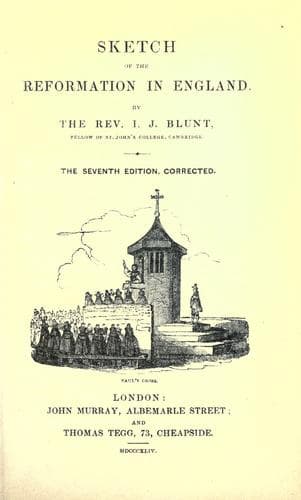
Sketch of the Reformation in EnglandBlunt, John J. (John James)
History
Sketch of the Reformation in England
Blunt, John J. (John James)
Great Britain -- Church history; Reformation -- England
The progress of the Reformation was attended (as all great national
convulsions are) with many and sad excesses. The work of destruction,
when long continued, is in itself a thing which hardens the heart and
the Reformation was full of it. Monk and nun turned out of house and
home, pensioned indeed, but (except in the case of superiors, who
were treated with more lenity) pensioned with a miserable equivalent;
their dwelling-places, beautiful as many of them were, laid low,
that all hope of return might be cut off, their cells surrendered
to the bats and owls; their chapels made a portion for foxes, the
mosaic pavements torn up, the painted windows dashed in pieces, the
bells gambled for, or sold into Russia and other countries,[275]
though often before they reached their destination buried in the
ocean--all and utterly dismantled, save, where, happening to be parish
churches, also, as was the case at St. Alban’s, Tewkesbury, Malvern,
and elsewhere, they were rescued in whole, or in part, from Henry’s
harpies, by the petitions or the pecuniary contributions of the pious
inhabitants;[276] libraries, of which most monasteries contained one,
treated by their new possessors with barbaric contempt; “some books
reserved for their jakes, some to scour their candlesticks, some to
rub their boots, some sold to the grocers and soap boilers, and some
sent over the sea to book-binders, not in small numbers, but at times
whole shipsful, to the wondering of foreign nations; a single merchant
purchasing at forty shillings a piece two noble libraries to be used
as gray paper, and such as having already sufficed for ten years were
abundantly enough (says the eye-witness whose words are here quoted)
for many years more;[277] these were some of the coarser features of
those times; howbeit there were many besides these. For the churches
were now treated with gross irreverence; horses and mules were led
through them; they were profaned by dogs and hawks, by doves and owls,
by stares and choughs;[278] they were plundered of their plate by
churchwardens, or other powerful parishioners,[279] who might argue,
that if they spared, others would spoil; or who might wish ill to the
cause of the Reformation, and take such means to scandalise it. London,
says Latimer, was never so full of ill; charity was waxen cold in it.
“Oh, London, London,” cries this earnest old man, “repent, repent! for
I think God more displeased with London, than he ever was with the city
of Nebo.”[280] Such was the profligacy of its youth, that he marvels
the earth gaped not to swallow it up. There were many that denied the
immortality of the soul, and the existence of a heaven or hell.[281]
Manly sports and pastimes had been exchanged for the gaming-table.
Divorces, even amongst the inferior classes of society, were become
common; for, marriage being declared no sacrament, probably many
chose to interpret the declaration to mean that it was no bond.[282]
Public-domain text, read in full here on John Shaqi.
Reviews
Reviews
No reviews yet
Be the first to share your thoughts on this work.
Elsewhere in the archive
Join the Discussion
Join the discussion
Sign in to leave a comment or review.
Sign InorCreate an account