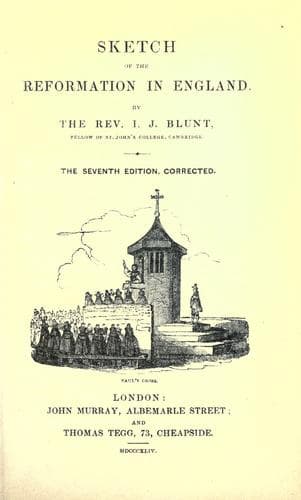
Sketch of the Reformation in EnglandBlunt, John J. (John James)
History
Sketch of the Reformation in England
Blunt, John J. (John James)
Great Britain -- Church history; Reformation -- England
satisfy his manes best by giving it to a man who would now show his
pupils a more excellent way, and that Newton was right and Ptolemy
wrong; though contrary to the ill-informed notions of the founder
himself; and though he, like the Jesuits,[272] would possibly have
denounced the innovation as heretical; but they would not be thought
to execute their trust to his satisfaction or to their own credit, if
they voted astronomy in general to be mere moonshine, and spent the
fund that was set apart for its encouragement in an annual dinner. Yet
this is the doctrine with regard to the responsibility of the state
for the due preservation of the church establishment which is often in
these days preached, as though the state were _owners_ of church
property instead of its _trustees_, and it was lawful for the
state to do what it would with that which it never gave, and which it
never had to give.[273] But might overcomes right--
There is a simple plan,
That they shall take, who have the power,
And they shall keep who can.
And accordingly the council of Cromwell prevailed with the king and the
courtiers, and Cranmer and Latimer had nothing to do but to submit and
make the most of such resources as were left. Indeed, the whole aspect
of the Reformation exhibits marks of the conflict of principles, under
which it was brought about. The best and the worst men were busy in
promoting it, each party with a purpose of their own; and its graces
and imperfections alike testify that the hands which were concerned in
it were not of one fashion; that its walls, like those of the second
Jerusalem, arose amidst fightings from without, “the builders every
one having his sword girded by his side, and so building.”[274] Happy,
indeed, it was that such master-builders were to be found: had not
this wise and conservative party been at hand, a party intent upon
what could be spared as well as what must be sacrificed--what could
be restored, as well as what must be destroyed utterly--the vulgar
handlers of axe and hammer would have cast all to the ground, and the
country would have risen from its paroxysm, rid indeed of superstition,
but with nothing for a substitute, and the latter state of the nation
would have been worse than the first. As it was, the troubled fountain
of the Reformation sent forth streams, the one of sweet, the other
of bitter waters, and as the principles of the blessed martyrs, who
acted in it their immortal parts, issued out in the establishment of a
church of apostolic doctrines, so did other principles, now stirred,
find their consummation (if indeed they found it then) in the eventual
subversion of that church, and with it, of the throne.
Public-domain text, read in full here on John Shaqi.
Reviews
Reviews
No reviews yet
Be the first to share your thoughts on this work.
Elsewhere in the archive
Join the Discussion
Join the discussion
Sign in to leave a comment or review.
Sign InorCreate an account