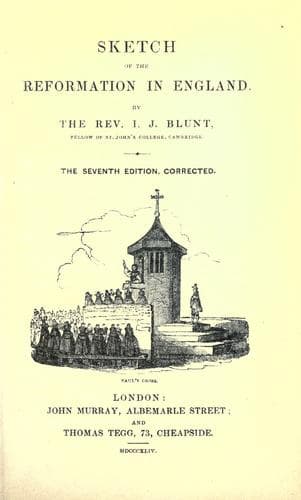
Sketch of the Reformation in EnglandBlunt, John J. (John James)
History
Sketch of the Reformation in England
Blunt, John J. (John James)
Great Britain -- Church history; Reformation -- England
Gardiner, however, once dominant, maintained the ascendency of the
Romish party and principles to the last of Henry’s reign. He had,
indeed, powerful coadjutors. The Howards were devoted to the same
cause; and the natural influence of that distinguished house was then
accidentally increased by the alliance which the king was about to form
with one of its members. Then, again, he strengthened himself by the
king’s fears. If he found him making any demonstrations of a nearer
approach to the Reformers, he could threaten him with the displeasure
of the emperor, and picture to him the jealousy with which he was
already regarded by the European powers, as the royal ringleader of
heresy. The expectation too of a general council shortly to be held
for the settlement of religious differences, and which finally fixed
itself at Trent, threw its weight into the same scale. Henry might
think it his policy not to commit himself farther with the faithful
sons of the church till the storm was overpast. Not was it a slight
matter in favour of Gardiner, that the king, in a rash hour, had
become an author; that his sentiments on the leading doctrines of the
Reformers were put upon irrevocable record; and that now to flinch
from his positions would be to resign the laurels which his reputed
scholarship had won for him; and, what was still less to his taste,
would be to pronounce that in matters of opinion even he himself was
not infallible. No man was better qualified to take advantage of these
or any other incidents which might make for his object than Gardiner,
the most astute politician of his time; while Cranmer, on the other
hand, had nothing to oppose to him but the spirit of an Israelite
indeed, alike unfit for contriving plots himself, or for discovering
them in another; for of him it might have been said; as it was said of
one of his most conspicuous successors in the see of Canterbury (though
a character upon the whole very different from his), that “too secure
in a good conscience, and most sincere worthy intention, with which no
man was ever more plentifully replenished, he thought he could manage
and discharge the place and office of the greatest minister in the
court without any other friendship or support than what the splendour
of a pious life and his accomplished integrity would reconcile to
him; which was an unskilful measure,” adds the great historian, whose
experience it is presumptuous to question, yet whose conclusion it
is painful to admit, “in a licentious age, and may deceive a good
man in the best of times that shall succeed; which exposed him to
such a torrent of adversity and misery, as we shall have too natural
an occasion to lament in the following discourse, in which it will
be more reasonable to enlarge of his singular abilities and immense
virtue.”[305] Soon had Cranmer reason to exclaim of those now admitted
into the king’s counsels, “Ye are too hard for me!” for now is past the
Public-domain text, read in full here on John Shaqi.
Reviews
Reviews
No reviews yet
Be the first to share your thoughts on this work.
Elsewhere in the archive
Join the Discussion
Join the discussion
Sign in to leave a comment or review.
Sign InorCreate an account