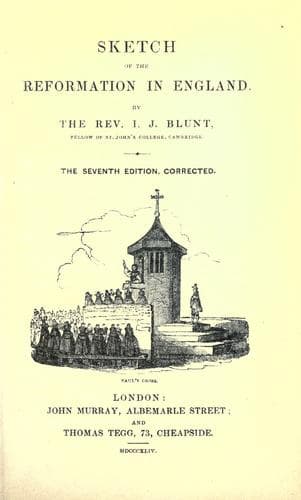
Sketch of the Reformation in EnglandBlunt, John J. (John James)
History
Sketch of the Reformation in England
Blunt, John J. (John James)
Great Britain -- Church history; Reformation -- England
act of the Six Articles (the whip with six strings as it was called),
the death-warrant of so many innocent men, whereby, 1. the doctrine
of transubstantiation was established by law; 2. the communion in
both kinds excluded; 3. the marriage of priests forbidden; 4. vows of
celibacy declared obligatory; 5. private masses for souls in purgatory
upheld; and 6. auricular confession pronounced expedient, and necessary
to be retained. The penalties annexed to the breach of these decrees
being for the first, to be burnt as a heretic, for the others to be
hanged as a felon, and in all cases to forfeit lands and goods to the
king as a traitor. Against these sanguinary articles Cranmer lifted up
his voice in parliament for three days together in vain. He, on that
occasion, was acknowledged by his opponents to have played a noble
part; and the king, whose redeeming virtue it was to deal kindly with
this single-hearted man, expressed his sense of the zeal, the honesty,
and the learning with which he had withstood court and parliament to
the face; by commanding the chief lords to dine with the archbishop
at Lambeth after the bill was passed, and to “signify unto him that
it was the king’s pleasure that all should in his Highness’ behalf
cherish, comfort, and animate him.”[306] The king, who understood
the beauty of his character, was faithful to his pledge, however
faithless were some of his messengers; and within two years after,
when two several attempts were made--the one by the clergy, the other
by the council, and both probably by Gardiner--to bring the archbishop
under the operation of this cruel act, and so to run him down, Henry
generously interposed, and casting his sceptre before the pack that
was open-mouthed to tear this noble quarry in pieces, called them off,
and rescued the victim.[307] It is singular, and characteristic of the
man, and of his unsuspicious temperament, that in both instances his
sovereign was the first person to apprise him of his danger; in the
one case calling him into his barge, as he passed by Lambeth Bridge,
and addressing him--“O my chaplain, now I know who is the greatest
heretic in Kent,” and thereupon putting him in possession of the
charges of his accusers, and giving him directions for vindicating his
own innocence, and bringing his enemies to shame; in the other case
sending for him out of bed at midnight, and acquainting him that the
council had demanded his commitment to the Tower, as being one who
sowed heresy and sedition throughout the realm, and that the next
day the deed was to be done. What follows is a scene of very touching
beauty, whether as given by Fox or Strype; and as the incident is
full of dramatic effect, it is happy that Shakspeare has set upon it
his own mark, and thereby rescued it from the clownish hand of any
ordinary playwright. At the same time it may be remarked, that his
characters have their parts allotted to them without any very strict
Public-domain text, read in full here on John Shaqi.
Reviews
Reviews
No reviews yet
Be the first to share your thoughts on this work.
Elsewhere in the archive
Join the Discussion
Join the discussion
Sign in to leave a comment or review.
Sign InorCreate an account