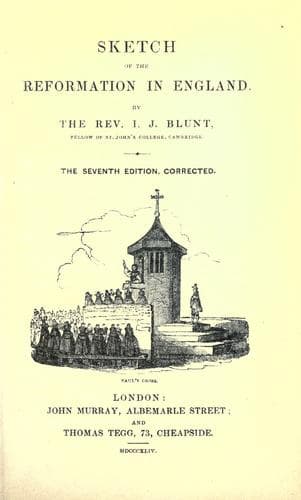
Sketch of the Reformation in EnglandBlunt, John J. (John James)
History
Sketch of the Reformation in England
Blunt, John J. (John James)
Great Britain -- Church history; Reformation -- England
again, must be imputed to the circumstances under which a preacher
before the Reformation, and indeed for many years subsequent to it,
delivered his sermon. It was very frequently in the open air that he
spake--from the steps of a cross, as at Paul’s Cross, the most famous
of the day; the congregation assembling around it, and only adjourning
to the “shrouds” (as some of the vaults of the church were called) when
the weather was unfavourable. Latimer’s sermons before Edward VI. were
preached in a garden of the palace of Westminster, the people having
admission, and the king hearing them from one of his windows.[315] The
effect of such an arrangement was, to divest sermons of all form; to
render them vernacular and colloquial: they were, in fact, what their
name indicates--not harangues, nor orations, but unwritten discourses,
or at most from notes,[316] and partook of all the characteristics
of ordinary discourse; the preaching from “bosom sermons,” or from
writing, being considered a lifeless practice before the Reformation,
and a fit subject of reproach; and the origin of it was, perhaps, no
other than an apprehension of the preacher in those days of jealousy,
lest he should be caught in his words, and misrepresented to those
in power, which induced him to commit his thoughts to paper; or a
determination of his superiors that he should be held to whatever he
uttered from the pulpit, which compelled him to do so.[317] Something
again, is to be referred to the connection which subsisted in Roman
Catholic times between the church and the stage. The Bible histories
were dramatised; a generation which had not the Scriptures to read,
and could not have read them if they had, were taught by theatrical
representation. It was upon this principle that the use of images
was defended: they were said to be the poor man’s books; and miracle
plays were actually performed in the churches. This ill-omened union,
however, without exalting the theatre, debased theology, and constantly
justified the apprehensions which Andrew Marvel expressed in the
particular instance of Paradise Lost, lest the poet
“Should ruin (for he saw him strong)
The sacred truths to fable and old song;”--
or lest,
----“if a work so infinite be spann’d,
Jealous he was that some less skilful hand
(Such as disquiet always what is well,
And by ill imitating would excel)
Might hence presume the whole creation’s day,
To change in scenes, and show it in a play.”
Public-domain text, read in full here on John Shaqi.
Reviews
Reviews
No reviews yet
Be the first to share your thoughts on this work.
Elsewhere in the archive
Join the Discussion
Join the discussion
Sign in to leave a comment or review.
Sign InorCreate an account