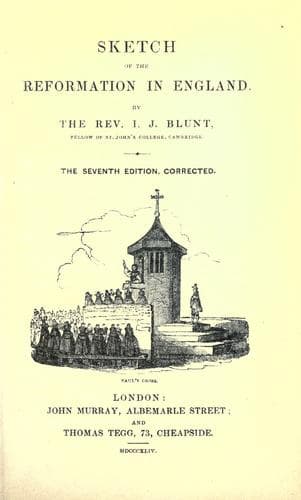
Sketch of the Reformation in EnglandBlunt, John J. (John James)
History
Sketch of the Reformation in England
Blunt, John J. (John James)
Great Britain -- Church history; Reformation -- England
3.;) when, in a fond imitation, as he says, of Latimer’s
famous card sermons, he followed out the metaphor of _dealing_; that
men should play _above-board_, or avoid dissimulation; not _pocket_
the cards, or improve their gifts; _follow suit_, that is, wear the
surplice, and conform to ceremonies.[313] Jeremy Taylor sometimes
narrowly escapes the like extravagance. South approaches it still more
frequently, and almost with as little ceremony as would have been
used a century earlier; and even in the majestic and sober Barrow,
expressions, if not figures, occasionally startle us, as below the
dignity of the pulpit and the gravity of the Christian teacher. Even
he does not scruple to talk of “time rendering God’s goodness more
precious, as it doth gold and wine,”--of the difficulty of curing a
wounded reputation, and “spreading the plaster so far as the sore hath
reached,”--of “the fox who said that the grapes were sour, because he
could not reach them; and that the hare was dry meat because he could
not catch it,”--of the man who would have his sickle in another’s
corn, or an oar in another’s boat, being in no condition to wonder
if his fingers be rapped,”--of “liberality being the most beneficial
traffic that can be, seeing that it is bringing our wares to the best
market, and letting out our money to the best hands; God repaying
us with vast usury, an hundred to one being the rate he allows at
present, and above a hundred millions to one the rate he will render
hereafter, so that if we will be merchants this way, we shall be sure
to thrive.”[314] Soon after this time pulpit oratory began to go upon
stilts; and, becoming more remote from the conceptions and phraseology
of the vulgar, lost much of its interest with them, and influence over
them, and at length made way for the field preacher, who spoke to them
once again, as it were, in the Hebrew tongue, to which they gave the
more silence. Whilst, however, we may regret the want of the nervous
asperity of style and profusion of matter of the days of Barrow, we may
congratulate ourselves upon our escape from the old-wives’ tales of the
days of Latimer. They had their origin in a very different state of
society, and a very different condition of the church. Something must
be ascribed to the general rudeness of an age when bear-baiting was
the amusement which a queen provided for the foreign ambassadors, and
of which herself and her court were willing spectators;--when a fool
was a part of the establishment even of the most refined households,
and his uncouth jokes were paid for by the year;--when the martyr in
prison could in all sober sadness address words of comfort to his
fellow-sufferer, “_Green_,” as a dainty dish for the Lord’s own tooth;
or to _Philpot_, as “a pot filled with the most precious liquor;”--and
when at the stake, not think it out of character, or out of season,
to crack a jest upon his own dress or his own corpulence. Something,
Public-domain text, read in full here on John Shaqi.
Reviews
Reviews
No reviews yet
Be the first to share your thoughts on this work.
Elsewhere in the archive
Join the Discussion
Join the discussion
Sign in to leave a comment or review.
Sign InorCreate an account