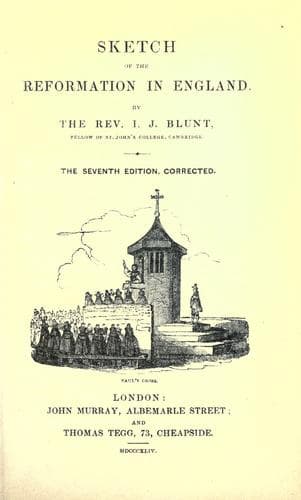
Sketch of the Reformation in EnglandBlunt, John J. (John James)
History
Sketch of the Reformation in England
Blunt, John J. (John James)
Great Britain -- Church history; Reformation -- England
It has been said, that from the date of the dissolution of the
religious houses, the Reformation laboured in its progress. Even Henry
seems to have been appalled at the violent reaction which followed,
and to have held his hand. But those wise and good men whose object it
had been all along to save what they could of the wreck, out of which
to construct another ark, were still on the watch to promote the great
cause in which they were embarked, both by permanent institutions and
present instruction. Accordingly, whoever might be the advisers of
the measure, out of the spoils of the monasteries six new bishoprics
were now founded--those of Westminster (since suppressed), Chester,
Gloucester, Peterborough, Oxford, and Bristol, together with deaneries
and prebends respectively annexed, all slenderly endowed, and upon
the whole a sad falling off from the splendid expectations which the
king had originally held forth of eighteen new sees, together with a
proportional number of suffragrans--expectations which the act of
suppression had encouraged, and by which many were reconciled to the
confiscation of the church property, as hoping that it was only to
be fused and cast into a better mould. Its authors, however, “liked
not that paying again; it was a double trouble.” Accordingly they
compounded with the creditor, and the dividend (with the addition of
funds for the endowment of some of the metropolitan hospitals, a few
professorships in either university, and a college in Cambridge,) was
what we have seen. The cathedrals fared better than the monasteries;
having been hitherto in the hands of the regulars, they were now put
upon the same footing as the new institutions of the like kind, and
their revenues appropriated to the maintenance of secular dignitaries.
Here, however, the plan proposed by Cranmer, owing probably to the
opposition of the Roman Catholic party, was not adopted. In the
settling down of the establishment once more, it was his wish that
the cathedrals should be converted into theological colleges; that
readers of divinity, of Hebrew, and of Greek should be attached to
them; that a body of students should be maintained in them, out of
whom the bishops might always find clerical recruits duly qualified
for the pastoral office; that here, in short, should be realised a
second time the institution which Samuel (the great reformer of his
own church) established throughout all the land of Israel, “schools
of the prophets,” and that thus might be filled up most effectually
the gap which had been occasioned in the system of public instruction
by the extinction of the religious orders. What might have been the
effect of such a measure, which would have completed the Reformation
in an important particular where it was left greatly defective, it
may now be in vain to conjecture. Whether such establishments might
not have contributed to stave off the crisis which was at hand from
Public-domain text, read in full here on John Shaqi.
Reviews
Reviews
No reviews yet
Be the first to share your thoughts on this work.
Elsewhere in the archive
Join the Discussion
Join the discussion
Sign in to leave a comment or review.
Sign InorCreate an account