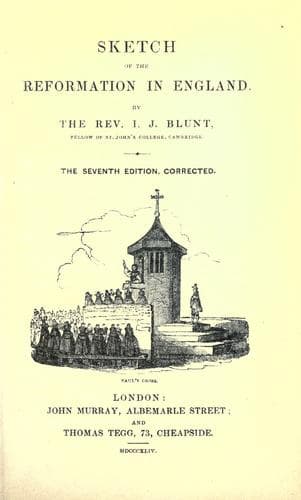
Sketch of the Reformation in EnglandBlunt, John J. (John James)
History
Sketch of the Reformation in England
Blunt, John J. (John James)
Great Britain -- Church history; Reformation -- England
the puritans--a party then beginning to take a shape, and which owed
its rapid development to the ineffectual opposition presented to it
by a feeble and ignorant clergy--whether much schism and separation
of a more recent date might not have been escaped by the aspect
which these conspicuous pillars of orthodoxy would have presented in
different districts, and to which public opinion might have looked,
as to light-houses, for a guidance--whether, fertile as our church
has been in great divines, the harvest might not have proved still
more abundant when a regular theological education, comprising a sound
knowledge of Hebrew, of the Fathers, of whatever else might conduce
to the formation of the instructed scribe, fell systematically to
the lot of all who were intended for the ministry;--whether a cheap
education like this would not have afforded opportunities for youths
of promise amongst the poorer classes to emerge from obscurity, and
to enter a profession for which nature had fitted them, but accident
had shut to the door; whether the church would not have been a gainer
by the additional talent which would thus have been called forth in
her service, when the “yeoman’s sons,” by whom, according to Latimer,
“the faith in Christ had been hitherto maintained chiefly,” and “the
husbandman’s children,” who are often endowed (as Cranmer strenuously
argues upon this very subject) with singular gifts, would have sent in
their contribution to the public stock;--and whether that same cause
of attachment which bound the common people to the friars, and through
them to the church itself, namely, the feeling that they had a personal
interest and relationship in many of its ministers, would not have been
hereby more effectually perpetuated:--or, on the other hand, whether
such institutions might not have withdrawn the clergy too much from
all secular intercourse, and prevented those connections of private
friendship or private tuition from being formed, to which our schools
and universities give occasion;--whether the alliance between church
and state is not principally continued by such interlacements, and
would not be greatly weakened by their disruption;--whether, again,
the provision which our cathedrals (on their present footing) offer
to the younger sons of powerful families (as the monasteries once
did) does not pledge those families more deeply to the maintenance of
the establishment;--whether the rewards, again, which they enable the
church occasionally to confer on those who have done her good service
as men of letters may not contribute to create a learned clergy, by
furnishing the means of learned leisure--is altogether a problem which
it is much more easy to state than to solve.
Public-domain text, read in full here on John Shaqi.
Reviews
Reviews
No reviews yet
Be the first to share your thoughts on this work.
Elsewhere in the archive
Join the Discussion
Join the discussion
Sign in to leave a comment or review.
Sign InorCreate an account