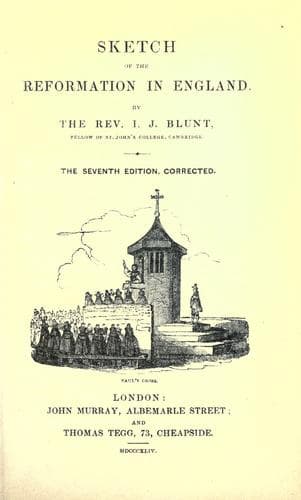
Sketch of the Reformation in EnglandBlunt, John J. (John James)
History
Sketch of the Reformation in England
Blunt, John J. (John James)
Great Britain -- Church history; Reformation -- England
articles_, to whom he had given his opinion upon them in writing.”
Certain it is that in the very next year these of King Henry came out,
and that the definition of justification contained in one of them is a
translation from the “Loci Theologici” of this Lutheran reformer.[318]
Nor was this all: the measure which was dealt out to the degenerate
Jews by Antiochus and his servants had, in a lower degree, long
obtained amongst the ecclesiastical powers in England. “When they
had rent in pieces the book of the law which they found, they burnt
them with fire; and wheresoever was found with any the book of the
testament ... the command was, that they should put him to death. Thus
did they by their authority unto the Israelites every month, to as
many as they found in their cities.”[319] But in the year 1537, the
whole Bible translated into English by Tindall, Rogers, and perhaps by
Coverdale[320] (the staple of all future editions,) bearing, however,
at first the title of Matthew’s Bible, the better to recommend it,
Tindall having recently died in the full odour of heresy, was published
in England; and by the influence of Cranmer and Cromwell, the king’s
license was procured that it should be freely bought and sold, and his
command issued that a copy of it should be set up in every church.
This was a day of rejoicing to the Archbishop Cranmer, greater, says
he, “than had there been given him a thousand pounds.”[321] Nor to
him only; the people, long thirsty for the word, now rushed to the
waters of life and drank freely: whosoever had the means bought the
volume; where the cost was too great for an individual, neighbours and
fellow-apprentices would unite purses and buy in common; a man would
be seen at the lower end of his church on a Sunday reading it aloud,
whilst numbers flocked about him to listen and learn; and the one
great topic of the time made its way even into taverns and alehouses,
where it seems to have been often the subject of vehement and angry
debate.[322]
Public-domain text, read in full here on John Shaqi.
Reviews
Reviews
No reviews yet
Be the first to share your thoughts on this work.
Elsewhere in the archive
Join the Discussion
Join the discussion
Sign in to leave a comment or review.
Sign InorCreate an account