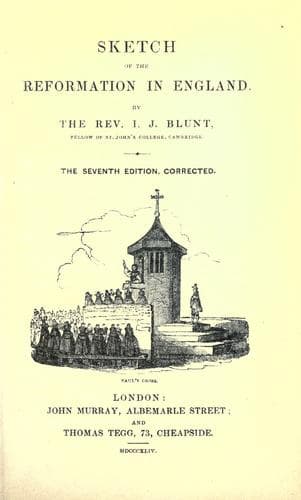
Sketch of the Reformation in EnglandBlunt, John J. (John James)
History
Sketch of the Reformation in England
Blunt, John J. (John James)
Great Britain -- Church history; Reformation -- England
Nor had the Reformers only to watch their opportunity for the
foundation of permanent institutions by which religion might be then
and for ever promoted; but whenever a favourable moment was afforded
for putting forth sound instruction to the people, they had to seize
upon it. During the reign of Henry this could only be done by being
instant in season, the season too being generally short, and always
precarious; liable to be affected by the character of a marriage, and
the duration of it; by a continental treaty; by a vote in parliament
satisfactory or the contrary; in short by the humour of a prince at
once in the highest degree capricious and resolute. Something, however,
was done; and we shall now gather up a few dropped stitches which we
have intentionally passed in this chapter, in order that our subject
might meet with no interruption.
The vulgar work of destruction did not prevail; even under Henry, to
the total exclusion of every other. In 1536, certain articles were set
forth by the convocation, and with the king’s authority, which had
for their title, “Articles devised by the Kinge’s Highness’ Majestie
to stablyshe Christen quietnes,” &c., much diversity of opinion
having sprung up in the country, as the preamble informs us, both
upon the essentials and ceremonials of which they treat. They are ten
in number, and rather indicate that a reformation was abroad, than
that it was achieved. They allow the use of images, but endeavour to
guard against their abuse; sanction prayers to the saints, but with a
caution against superstition; defend the doctrine of purgatory, though
with some hesitation, and with a positive rejection of pope’s pardons
and masses of _scala cœli_; assert the sacraments of penance,
baptism, and the Lord’s Supper; maintaining, with regard to the two
latter, that infants dying before baptism perish everlastingly, and
that the real body and blood of our Lord is present in the elements;
but justification on the ground of merit they disclaim altogether,
giving to Christ, and to Him only, the praise; and the faith of a
Christian they consider to be comprehended in the canonical Scriptures,
and the three creeds alone. It may be well to observe, inasmuch
as the observation throws some light upon the spirit in which the
formularies of our church were conceived, even at this remote period
of the Reformation, that Melancthon is with reason believed to have
had a voice in the Articles of 1536. So early as 1534 he was pressed
to come to England and assist in completing the regeneration of the
church; and invitations to the like effect continued to be forwarded to
him. In 1535 we find him suggesting, by letter to Henry, the necessity
of issuing a simple form of doctrine, such as might be agreed upon
by learned men; and at the same time adding, that Dr. Barnes, whom
he calls Antonius (afterwards the martyr but then Henry’s ambassador
in Germany,) had been “very carefully discussing with him _certain
Public-domain text, read in full here on John Shaqi.
Reviews
Reviews
No reviews yet
Be the first to share your thoughts on this work.
Elsewhere in the archive
Join the Discussion
Join the discussion
Sign in to leave a comment or review.
Sign InorCreate an account