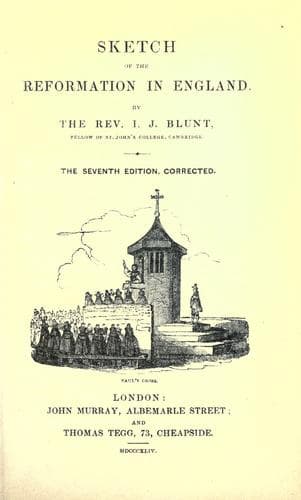
Sketch of the Reformation in EnglandBlunt, John J. (John James)
History
Sketch of the Reformation in England
Blunt, John J. (John James)
Great Britain -- Church history; Reformation -- England
In 1543 another work appeared, under the sanction of the king and
the convocation:[328] it had for its title, “A Necessary Doctrine
and Erudition for any Christian Man,” and was vulgarly called “the
_King’s Book_.”[329] It was, in fact, the _Bishops’ Book_
revised, with some additional matter touching free will, good works,
justification, predestination, purgatory--subjects which now began to
be discussed with great warmth and difference of opinion. On comparing
it with its prototype, it will be seen how far from progression
the Reformation had been during the interval. It came out, indeed,
whilst the act of the Six Articles was in force, and Gardiner in
power. The wonder, therefore, is, rather that it says so much, than
that it does not say more. The truth, however, seems to be, that it
was an act of compromise; a boon granted to the reformers (rendered
equivocal, indeed, by an infusion into it of the spirit of the Bishop
of Winchester),[330] in consideration of the sacrifice that was about
to be required of them; for the Bible in the vulgar tongue was now to
be once more withdrawn. To those “whose office it was to teach other,
the having, reading, and studying of Holy Scripture (it seems) was not
only convenient, but also necessary; but for the other part of the
church ordained to be taught, it ought to be deemed, certainly, that
the reading of the Old and New Testament was not so necessary for all
those folks.” For them it was enough to hear; and that nothing might
be wanting to convince, Scripture itself was quoted in support of
this sentiment--“Blessed are they that _hear_ the word of God,
and keep it;” where it is insinuated, for it would have been too bad
to affirm it, that the blessing attaches to those who _hear_,
not to those who read.[331] But if we meet with a stumbling-block on
the threshold of this new publication--for the passages alluded to
are in the preface--on further acquaintance with it we shall find our
suspicions, that Gardiner’s hand had been busy in it, strengthened.
The depravity of our nature, so stoutly insisted upon in the Bishops’
Book, is nearly overlooked in the parallel passage of the King’s
Book,[332] and the good offices of our Lord for the recovery of man
are set forth in a much less lively manner in the latter than in
the former place; where the one has enlarged upon the sufferings of
Christ chiefly as propitiatory, the other, though not disclaiming this
consideration, rather descants upon them as exemplary;[333] whilst
the one declares the condemnation of every man to be sufficiently
established, even though he were to be tried by the tenth commandment
alone, the other evades the humiliating confession;[334] when the one
denies even martyrdom to be a _meritorious_ cause of salvation,
and ascribes it altogether to the grace of God through Christ, the
other gives a different turn to the commentary, and escapes the
avowal:[335] in the one, the sacrament of matrimony is explained as
Public-domain text, read in full here on John Shaqi.
Reviews
Reviews
No reviews yet
Be the first to share your thoughts on this work.
Elsewhere in the archive
Join the Discussion
Join the discussion
Sign in to leave a comment or review.
Sign InorCreate an account