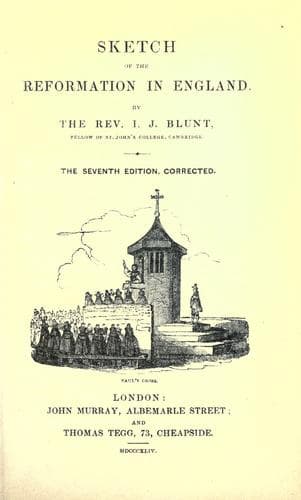
Sketch of the Reformation in EnglandBlunt, John J. (John James)
History
Sketch of the Reformation in England
Blunt, John J. (John James)
Great Britain -- Church history; Reformation -- England
that which God commands to some, leaves free to all; in the other, a
clause is inserted, excepting from its provisions priests and others
under vows of celibacy:[336] in the one, the exposition of the second
commandment begins thus--“By these words we are utterly forbidden to
make or to have any similitude or image, to the intent to bow down to
it, or to worship it;” in the other--“By these words we be _not_
forbidden to make or to have similitudes or images, but only we be
forbidden to make or to have them to the intent to do godly honour
unto them, as it appeareth in the xxvith chapter of Leviticus.”[337]
It is true that the ulterior interpretation of the commandment in the
two cases does not differ so materially as might be expected from the
respective introductions; still the introductions are sufficient to
show that the spirit in which the commentaries were made was not, in
both instances, quite the same. Other examples of a similar declension
in the principles of the Reformation might be gathered from a close
comparison of these documents; at the same time, it would afford some
minute indications that a better knowledge of the Scriptures had been
meanwhile diffusing itself over the country, and that the six years
privilege of consulting them had not been altogether lost. Thus, it
may be remarked, that in the Bishops’ Book we read of “_one_
Pontius Pilate being the chief judge in Jerusalem;”[338] whereas
in the King’s Book the same individual is called “Pontius Pilate,”
&c.,[339] as though he were a character with which the people were more
familiar: again, in the former, the legend of binding “Christ fast to a
pillar,” and so crowning and scourging him, is inserted in the details
of his passion;[340] in the latter, this incident is omitted, and the
scriptural account is strictly followed.[341] It is singular, too,
that, in the one, the escape of “Lot and his _three_ daughters”
is spoken of; a mistake which the other corrects, his “_two_
daughters” being here the reading.[342]
Public-domain text, read in full here on John Shaqi.
Reviews
Reviews
No reviews yet
Be the first to share your thoughts on this work.
Elsewhere in the archive
Join the Discussion
Join the discussion
Sign in to leave a comment or review.
Sign InorCreate an account