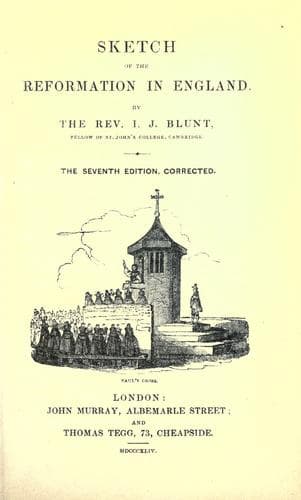
Sketch of the Reformation in EnglandBlunt, John J. (John James)
History
Sketch of the Reformation in England
Blunt, John J. (John James)
Great Britain -- Church history; Reformation -- England
everlastingly;”[358]--a phrase, it is true, merely rendered from
the Latin; but the translation exercises on some other occasions a
discretionary power of abridging; and whilst the former rejects the
church of Rome as a church, counting it to be such only in name, and
classing it even with the Turks,[359] the latter tempers its zeal with
a sounder judgment, and omits altogether so suicidal a statement:
the time came when Cranmer would have left these infants to the
uncovenanted mercies of God, saying within himself, “What is that to
thee? Follow thou me.” Still, this is characteristic of the several
stages of opinion through which he had to pass. A similar remark
applies to the doctrine of the holy communion, as here explained. It
is clearly that of the real presence; for though a distinction has
been taken between some expressions in the Latin catechism (which
certainly inculcates the Lutheran tenet), and the corresponding phrases
in the English translation, as though the former asserted the body
and blood of Christ to be _present_ in the sacrament, the latter
to be _received_ therein; still there are many places where such
a distinction does not obtain, and where the argument itself does
not seem to admit of it.[360] But, after all, why has it been made a
matter of reproach against Cranmer, that he was first a Catholic, then
a Lutheran, and lastly a Zuinglian in his notions on the Communion;
successively a believer in transubstantiation, in the real and in the
spiritual presence of the body and blood of Christ? This he was: for,
the first opinion he maintained when he argued against Lambert;[361]
the second, when he published his Catechism; the last, when he wrote
his book upon the sacrament. Gardiner might take advantage of such
changes, as in fact he did, and have his sneer; but nothing could be
more natural than that a sincere man, only intent on following out
truth, lead where it might, should have arrived at it by degrees, and
by precisely such degrees as these--that he should see men as trees
walking, before he saw them as men; and nothing can argue more strongly
the sound and sober principles upon which the Reformation proceeded,
than this its gradual advance. It was not, we find, without patient
investigation, and the successive abandonment of every false position,
as it proved itself to be such, that it ultimately attained the strong
ground from which it has never since been dislodged.
Public-domain text, read in full here on John Shaqi.
Reviews
Reviews
No reviews yet
Be the first to share your thoughts on this work.
Elsewhere in the archive
Join the Discussion
Join the discussion
Sign in to leave a comment or review.
Sign InorCreate an account