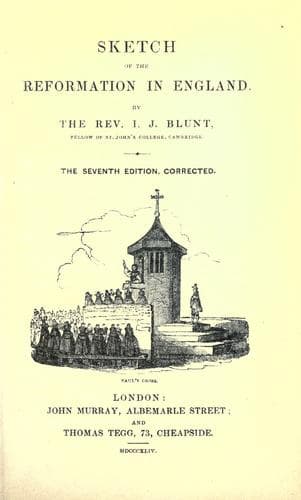
Sketch of the Reformation in EnglandBlunt, John J. (John James)
History
Sketch of the Reformation in England
Blunt, John J. (John James)
Great Britain -- Church history; Reformation -- England
which would rather have recommended themselves to the honest
extravagance of a Latimer than to the caution of a Cranmer, and which
have accordingly given occasion to many doubtful disputations both in
metaphysics and theology. Still, the _Homilies_ must have been
most wholesome lessons for those times, when minor differences were
merged in the broad distinction between Romanists and men of the new
learning, and in the one great struggle for the liberties temporal and
spiritual of the church of England.
Soon after this, in the year 1548, was published _Cranmer’s
Catechism_, as it was called, it being said in the title-page
to be “set forth” by him; a circumstance which led Burnet into the
mistake, subsequently corrected at the suggestion of Strype, that it
was composed by the archbishop. The truth is, that it was originally
written in German, and was probably one of the many catechisms to which
Luther’s own gave rise, and by which the Reformation in Germany was
forwarded. It was translated into Latin by Justus Jonas, the father
most likely (for there were two), the intimate friend of Luther; and
might have been brought into England by the son, a less conspicuous
character among the reformers, who came to this country in 1548, driven
from his home, like many more, by the religious ordinance of Charles V.
known by the name of the _Interim_. From the Latin it was turned
into English, faithfully for the most part, by some hand of Cranmer’s
own choosing, perhaps by Rowland Taylor the martyr, of glorious memory,
then one of his chaplains. It is drawn up on the same plan as the
Bishops’ Book and the King’s Book, which had preceded it; being an
exposition of the Creed, the Lord’s Prayer, and the Sacraments. As
Cranmer prefixed to the work his own name, it must be considered to
express his own opinions at the time; and its history is here traced
with the more care, because it presents another picture of the
progressive workings of his mind towards the point at which he finally
reposed, and another proof of the slow and painful process through
which he arrived at what he conceived to be the truth. Accordingly,
in his Catechism we still find the Commandments arranged after the
Roman Catholic usage, the second omitted, or consolidated with the
first, and the tenth divided into two. We find three sacraments still
insisted upon, though four others had been withdrawn--baptism, the bath
of regeneration, or instrument of the second birth;[357] absolution,
or the authority of the keys, by virtue of which pardon is obtained
for sins after baptism; and the holy communion, which administers
fresh supplies of grace to the worthy receiver, and enables him to go
on from strength to strength. Of the first of these three sacraments
it may be remarked, too, that the language is more dogmatical than
would have been used by Cranmer a few years later; “those who have
heathen parents, and die without baptism,” being said to be “damned
Public-domain text, read in full here on John Shaqi.
Reviews
Reviews
No reviews yet
Be the first to share your thoughts on this work.
Elsewhere in the archive
Join the Discussion
Join the discussion
Sign in to leave a comment or review.
Sign InorCreate an account