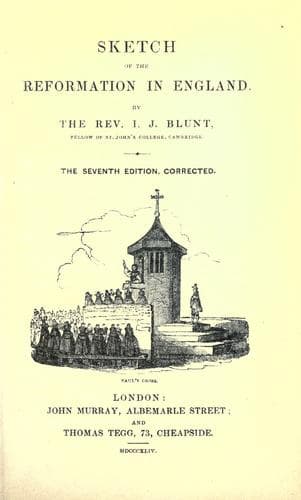
Sketch of the Reformation in EnglandBlunt, John J. (John James)
History
Sketch of the Reformation in England
Blunt, John J. (John James)
Great Britain -- Church history; Reformation -- England
The length of our church service, therefore, of which we now hear so
much, and the repetitions it contains, are evils, if evils they be,
which have been practically existing almost from its first formation;
which a Hammond, a Sanderson, and a Taylor could tolerate without
a complaint but too happy; (as were then their congregations also,
for those were not fastidious days,) if they were permitted in their
secret assemblies to give utterance to these burning words with which
the great Reformers had furnished them; nor scrupulously counting
how often they were taught to pour forth the Lord’s Prayer; as they
counted not how often they were taught to cry out in the self-same
phrase for the Lord to have mercy upon them; as David counted not how
often he exclaimed “My son, my son;” or as these critics themselves,
it is presumed, would not count their own iterations when they were
suing earnestly for their lives. Such are not vain repetitions; and
it is to be hoped, that an age so little fitted for the task as
this by any theological attainments, will pause before it attempts
to improve upon the labours of a Cranmer, who, according to the
testimony of one of the ripest scholars of his time, Peter Martyr,
nor he, by any means a creature of the archbishop, “had diligently
noted with his own hand every one of the fathers; had digested into
particular chapters, with a view to the controversies of his day,
councils, canons, and popes’ decrees pertaining thereto, with a toil,
and diligence, and exactness, which would seem incredible to any but
an eye-witness; who both publicly and privately, and by a marvellous
strength of learning, quickness of wit, and dexterity of management,
had asserted what he held to be true from the thorny and intricate
cavils of sophisters;”[377] and who pronounced concerning this very
Book of Common Prayer, “that no man could mislike that godly book that
had any godliness in him joined with knowledge;”[378]--Moreover that
an age, which for a long time, unchastened by any national calamity,
has suffered much of that spirit of devotion to escape which animated
the holy men of old, who were ever compelled to walk with their lives
in their hand, and who were, in fact, called upon at length to lay
them down, will not be allowed to communicate its narcotic influence
to our Liturgy, and quench in any degree the ashes of the martyrs. In
truth, it is impossible to contemplate the projects of our Liturgical
Reformers without something of alarm, lest, whilst with the best
intentions in the world they “dandle the kid,” they should clumsily
kill him nevertheless.
Public-domain text, read in full here on John Shaqi.
Reviews
Reviews
No reviews yet
Be the first to share your thoughts on this work.
Elsewhere in the archive
Join the Discussion
Join the discussion
Sign in to leave a comment or review.
Sign InorCreate an account