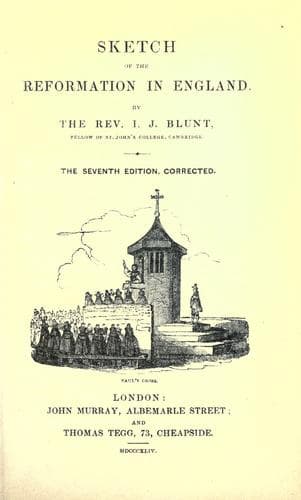
Sketch of the Reformation in EnglandBlunt, John J. (John James)
History
Sketch of the Reformation in England
Blunt, John J. (John James)
Great Britain -- Church history; Reformation -- England
If, however, changes there must be after all--if old things must
here, too, pass away, and all things become new--be the conditions
those proposed by the sagacious South, and all apprehensions will be
hushed. “Let us but have our Liturgy continued to us, as it is, till
the persons are born who shall be able to mend it, or make a better;
and we desire no greater security against either the altering this, or
introducing another.”[379]
Besides providing these various forms of public devotion, our Reformers
extended their care to those of the closet and household; and in
“The Primer, or Book of Private Prayer, needful to be used of all
Christians” (for so its title runs), and of which numerous editions
appeared from the dawn of the Reformation under Henry down to the
accession of Mary, successively portraying its progress by their
improvements upon one another, scriptural petitions are contained
suitable to all sorts and conditions of men, and almost to every state
of body or mind to which they are liable. Here are graces before
meat--addresses to God “both when we wake and when we seek his gift of
sleep;”--when we are “very sick,” and when our health is recovered--for
such as have an unquiet conscience, or an injured name--for such as
are in poverty or affluence--for kings and judges, gentlemen and
merchants, lawyers and labourers, parents and children, husbands and
wives, masters and servants--significant all, of the manner in which
the Reformers laboured to introduce a religious principle into all the
relations and transactions of life whatsoever; to extend its influence
over the whole of society, so that like Elisha stretched upon the
dead child (to use an illustration of Jeremy Taylor’s), it might give
life and animation to every part of the body politic. There is much
simplicity and beauty in the following prayers “for Landlords,” and
“for Householders,” which are extracted as specimens of a work now but
little known, having been overlaid by the extempore effusions of the
days of Cromwell, and never having recovered itself, like the Book of
Common Prayer, since.--[380]
“FOR LANDLORDS.
Public-domain text, read in full here on John Shaqi.
Reviews
Reviews
No reviews yet
Be the first to share your thoughts on this work.
Elsewhere in the archive
Join the Discussion
Join the discussion
Sign in to leave a comment or review.
Sign InorCreate an account