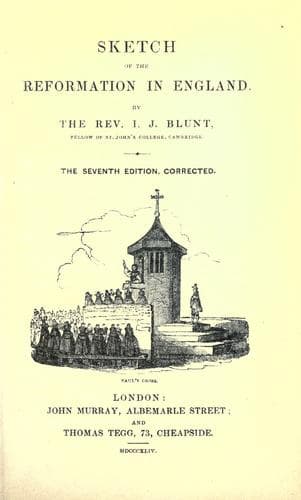
Sketch of the Reformation in EnglandBlunt, John J. (John James)
History
Sketch of the Reformation in England
Blunt, John J. (John James)
Great Britain -- Church history; Reformation -- England
Thus far have we accompanied our Reformers in their attempt to raise up
a Church of England, and to establish its doctrines. One important work
more under this head remained still to be done, and to that we must
now advert, the composition of a set of _Articles_ which should
speak with authority the opinions of the church, and secure uniformity
amongst its teachers. Cranmer had entertained this difficult project
in his thoughts long before he executed it; and the spirit in which he
buckled himself to the work may be collected from some demonstrations
which he had previously made. The natural effect of the Reformation
had been to put in motion various conflicting opinions upon matters
of faith and practice; every man challenging to himself the right of
private judgment, and many, no doubt, abusing it; for any principle,
however good, may be misapplied. It was, accordingly, the devout wish
of many of the leading Reformers, both on the Continent and in this
country, that some general creed should be drawn up by a congress of
learned men of all nations, which should bind the whole Protestant
church together, and put an end to these mischievous divisions of
heart. Melancthon appears especially to have pressed such a scheme upon
Cranmer, whom, in his turn, he found nothing loth to pursue it;[381]
for he seems to have entered into a correspondence on the subject with
some of the leading foreign Protestants; and Calvin’s own letters
(for to him he had written amongst others) bear testimony to the
comprehensive views of our archbishop upon this great question.[382] It
failed, however, as the same correspondence indicates; whether from the
troubles at that time prevailing both at home and abroad; whether from
the difficulty which must have been anticipated of constructing any
single form which should be acceptable to so many parties holding so
many opinions; or whether from the intrigues of the Council of Trent,
then sitting, which, taking alarm at the projected unanimity of their
adversaries, and acting upon the old policy of divide and conquer,
despatched their emissaries to the proper quarters, who, feigning
themselves zealous for the Reformation, and preaching those extravagant
doctrines of the Anabaptists, which all sober-minded men lamented and
condemned, scattered apples of discord amongst their enemies, and
dissolved them as a body.[383] But, however this might be, the scheme
was discovered to be impracticable, and Cranmer then contracted his
views, and confined himself to the preparation of Articles for the
Church of England only.[384]
Public-domain text, read in full here on John Shaqi.
Reviews
Reviews
No reviews yet
Be the first to share your thoughts on this work.
Elsewhere in the archive
Join the Discussion
Join the discussion
Sign in to leave a comment or review.
Sign InorCreate an account