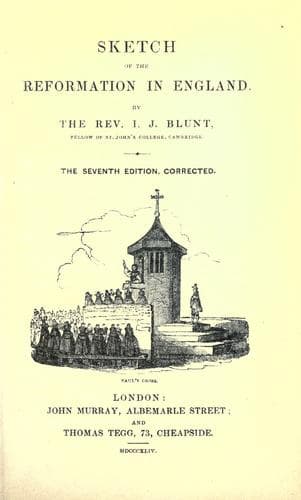
Sketch of the Reformation in EnglandBlunt, John J. (John James)
History
Sketch of the Reformation in England
Blunt, John J. (John James)
Great Britain -- Church history; Reformation -- England
It is of great importance to the right understanding of those which
he at length drew up, to consider the spirit in which they were
framed. Originating in the manner we have said, the principle which
dictated them could scarcely have been one of exclusion, but was
rather intended to allow a latitude, within certain limits to a
conscientious difference of opinion, and to make the fiery scorpion of
bigotry draw in its claws; and concede a just portion of the heavens
to other pretensions besides its own. That the spirit of our Articles
was thus catholic, became apparent in the actual working of them; and
accordingly, when the exclusive doctrines of Calvin triumphed for a
season in this country, and the Westminster divines were called upon
to remodel the church, one of their first acts was to review the
Articles, (a task which they did not complete, probably finding it a
business of too much moderation to suit their present temper,) with
the express design of rendering them “more determinate in favour of
Calvinism[385],” and a similar attack appears to have been meditated
upon them by the same party at the Savoy conference after the
Restoration;[386] sufficient testimonies these, that the exclusionists
did, in fact, feel the Articles (however they may have laid violent
claim to them as their own) to be conceived in a temper inconveniently
liberal, and the net of Cranmer and his coadjutors to have been cast,
in this instance, too wide to meet their approbation.
Nor will a closer examination of the history of their actual
composition lead to any other result. For the model upon which those
of Cranmer of 1553 were formed was the Confession of Augsburg, which
was strictly a Lutheran Confession, Melancthon himself having drawn it
up; and it is a curious fact, and like another to which allusion has
already been made (the frequent invitations sent to this great Reformer
to repair to England and take part in building up her church), a fact
indicating the influence which his character and opinions exercised
on the ecclesiastical proceedings of this country at that time, that
the divinity professorship in Cambridge, which was vacated by Bucer’s
death, in 1551, was not filled up for two years, apparently in the hope
that Melancthon (for whom it was intended) would be persuaded to come
over and occupy it;[387] the interval being precisely that in which
the Articles were concocted. Nor may it be impertinent to remark, that
on their revision under Archbishop Parker, previous to 1562, care was
taken to draw from the same, or at least a similar, fountain for what
was wanting; the additions and emendations bearing token, both in their
matter and language, of having been derived from the Confession of
Wirtemberg; a Confession composed in 1551, and exhibited at the Council
of Trent the following year, and which, like that of Augsburg, was
not Calvinistic, nor Zuinglian, but Lutheran.[388] Indeed, nothing can
Public-domain text, read in full here on John Shaqi.
Reviews
Reviews
No reviews yet
Be the first to share your thoughts on this work.
Elsewhere in the archive
Join the Discussion
Join the discussion
Sign in to leave a comment or review.
Sign InorCreate an account