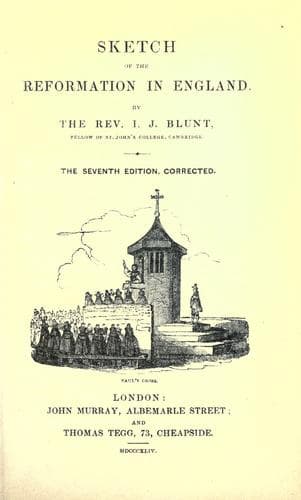
Sketch of the Reformation in EnglandBlunt, John J. (John James)
History
Sketch of the Reformation in England
Blunt, John J. (John James)
Great Britain -- Church history; Reformation -- England
The true key, indeed, to the right understanding of the articles (as
was already observed with regard to the homilies) is not so much the
doctrine of Calvin as of the schoolmen; the controversy lying chiefly
between the Protestant and Catholic, and in its paramount interest and
importance absorbing for a season every other. Thus the article of
“Original Sin” is urged with a reference to the scholastic dogma, that
original sin was a mere defect of original righteousness, the latter
being a quality superinduced, and not “the fault and corruption of the
nature of every man;”--the article of “Works before Justification,”
with a similar view to another theory of the subtle doctors, that by
a certain meritorious meetness, _a priori_, for the reception of
God’s grace, the party claimed it as a right _de congruo_, and
that having once received it, he then claimed its further extension as
a right, _de condigno_.[393] These opinions, so calculated to puff
up by making man the originator of his own justification, our Reformers
would not tolerate, and framed their confessions accordingly. It would
not fall within the plan of a work like the present to enter more
minutely into these investigations, which, after all, are as an hedge
of thorns; suffice it to have pointed out the general principle which
should not be lost sight of in forming our judgment of the articles.
Thus considered they will be scarcely thought to determine, or to be
intended to determine, the peculiar points of Calvinistic controversy
either way: they will be rather thought to be composed simply for the
purpose assigned in the title prefixed to the original articles, “for
the _avoiding of controversy_ in opinions, and the establishment
of a _godly concord_ in certain matters of religion;”[394] an
object which was not likely to be obtained by the decided adoption of
any party views, be that party what it might; and, therefore, King
James, according to his declaration prefixed to the Articles, “took
comfort that all clergymen within his realm had always most willingly
subscribed to the Articles established, which is an argument (he adds)
that they all agree in the true usual literal meaning of the said
Articles, and that even in those curious points in which the present
differences lie, men of all sorts take the Articles of the church of
England to be for them.” Yet nothing can be more certain than that in
the time of James the divisions of opinion upon speculative points of
theology were both wide and numerous; high and low church principles
(as they are called) never having been more violently opposed to each
other than then. Here, therefore, as in all other of their measures,
did the Reformers make their moderation known unto all men, not hoping
or desiring to confine religious opinion so closely as thereby to
prejudice religious sincerity, nor expecting that the pyramid of a
national Church would stand firm when set upon an apex instead of a
base.
Public-domain text, read in full here on John Shaqi.
Reviews
Reviews
No reviews yet
Be the first to share your thoughts on this work.
Elsewhere in the archive
Join the Discussion
Join the discussion
Sign in to leave a comment or review.
Sign InorCreate an account