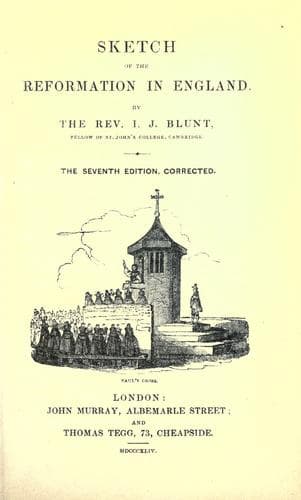
Sketch of the Reformation in EnglandBlunt, John J. (John James)
History
Sketch of the Reformation in England
Blunt, John J. (John James)
Great Britain -- Church history; Reformation -- England
On a review of these several works by which the Church of England
was restored, it can scarcely fail to be matter of admiration and
wonder, that so fair a fabric should have risen under the hands of the
Reformers out of such disorder, almost at once; that in the very agony
of a first attempt they should have thrown off a comprehensive scheme
of doctrine and devotion which scarcely called for any subsequent
revision; that they should not only have hewn out such admirable
materials, but have brought them, too, in so short a season, to so
excellent a work. In this our day (overcast and troubled as it is)
we can, perhaps, scarcely transfer ourselves, even in imagination,
to the tumultuous age of a Cranmer and a Ridley, or fully appreciate
the sagacity which, under God’s blessing, conducted them through
such conflicting elements with such signal triumph. Yet so it was;
and with the gorgeous ceremonies of the church they had grown up in
soliciting their senses on the one hand, endeared, too, by all the
holy recollections of their youth and even manhood; and contempt for
all decency of apparel and ritual, the natural reaction of former
abuses, assailing them on the other; these judicious men yielded
themselves to neither extreme, but adopting the _middle way_,
(alas! that Milton should bestow upon them no better title for this
than that of halting prelates,[395]) left us a church alike removed
from ostentation and meanness, from admiration of ornament and disdain
of it; a church retaining so much reverence for ancient customs, and
ancient forms, as not rashly to abolish them, and only so much as not
to adopt them blindly. Under the guidance of this principle it was
brought to pass that though this same church was not made to discover
the material flesh and blood of our Lord in the communion, it was
taught to discover (whatever Bishop Hoadley may say to the contrary)
more than mere commemorative emblems; that while she does not presume
to limit the regenerating influence of the Holy Ghost to the single
mode of baptism, and exclude from all possible admission into heaven
every soul of man which has not partaken of that rite, for “the Spirit
which works by means may be not tied to means,”[396] she declares it
generally necessary to salvation; that whilst she teaches the absolute
need of a Saviour and of a Spirit, to restore in us that image of God
which was greviously defaced by the fall, and imputes such restoration
to the merits of a Saviour and the influence of the Spirit, she thinks
it of inferior consequence to determine how far gone from original
righteousness we may be, resting satisfied with the assertion (to
the truth of which every one who knows his own heart must subscribe)
that we are at any rate “very far gone,” “_quam longissime_,” as
far as it is possible, consistently with the possession of a moral
nature at all, and responsibility for our actions; that whilst she
does not allow marriage to be a sacrament, as remembering, that it is
Public-domain text, read in full here on John Shaqi.
Reviews
Reviews
No reviews yet
Be the first to share your thoughts on this work.
Elsewhere in the archive
Join the Discussion
Join the discussion
Sign in to leave a comment or review.
Sign InorCreate an account