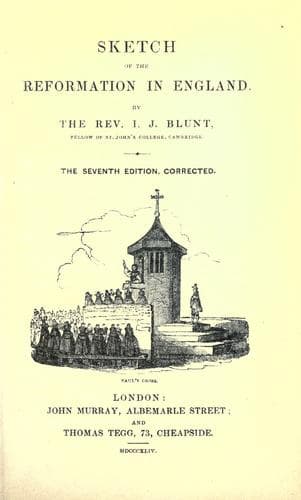
Sketch of the Reformation in EnglandBlunt, John J. (John James)
History
Sketch of the Reformation in England
Blunt, John J. (John James)
Great Britain -- Church history; Reformation -- England
with unwashen hands; and it is remarkable that, though according
to the strict letter of the Levitical law the Passover was to be
partaken of with loins girded, and shoes on the feet, and a staff in
the hand, and in haste, Jesus appears to have acquiesced in a custom
long established, and to have sat down with his disciples, and to have
conversed with them at his leisure, one of them leaning upon his bosom.
An attempt has been made by some to claim Cranmer as belonging to the
same party in his heart, howbeit restrained by force of circumstances
from fully declaring himself. They would persuade us that he was
prepared to have gone much further in his Book of Common Prayer, (such,
say they, was the report amongst the English exiles at Frankfort,)[399]
but that a wicked clergy and convocation held his hand; and that more
was meant than met the ear, even when under the cruel mockery of his
accusers, as they stripped him of the canvass pontificals in which they
had arrayed him, he observed, “that it needed not; for he had done
with that gear long before.”[400] That he set no greater store by the
innocent trappings of his office than was due to them from a man of
sense and piety may be well believed; he had already said as much: “If
the bishops of this realm,” he remarks in a letter to Cromwell, “pass
no more of their names, styles, and titles, than I do of mine, the
King’s Highness shall soon order the matter betwixt us.... For I pray
God never to be merciful to me at the general judgment if I perceive in
my heart that I set more by any title, name, or style, that I write,
than I do by the paring of an apple, further than it shall be to the
setting forth of God’s word and will.” Let it, however, be remembered,
that these words were written by Cranmer in vindication of himself
against the idle but malicious charge of Gardiner, that by assuming
the title of “Primate of all England” he had trenched upon the King’s
supremacy, and that the period at which they were written was the year
1535, when as yet the Puritan question had not been stirred.[401]
But though the general character of the Archbishop’s mind, which was
averse from extremes of every kind, is enough to oppose to any claim
of this description, there are, besides, some distinct particulars in
his history, which argue clearly enough that if he did not foresee the
danger of the Puritan principle, he at least had no inclination to lend
himself to its advancement. To Hooper’s imaginations he did not give
place, no not for an hour, resolutely opposing even the King’s letter
of recommendation that the ceremonies used in consecration might in his
particular case be dispensed with;[402] a degree of obduracy this, at
which the martyrologist (whose bias is well known) significantly hints,
“for he will name nobody,” as culpable in the Archbishop, and such as
called for the Cross to put an end by a real and terrible visitation
to unworthy contentions, and to unite men who ought never to have
Public-domain text, read in full here on John Shaqi.
Reviews
Reviews
No reviews yet
Be the first to share your thoughts on this work.
Elsewhere in the archive
Join the Discussion
Join the discussion
Sign in to leave a comment or review.
Sign InorCreate an account