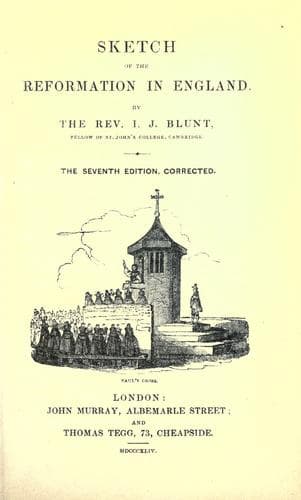
Sketch of the Reformation in EnglandBlunt, John J. (John James)
History
Sketch of the Reformation in England
Blunt, John J. (John James)
Great Britain -- Church history; Reformation -- England
been divided, by making them partners in bonds and in death. Nor is
this all; a trifle it may be, but still it is a trifle to our present
purpose, and characteristic of the temper of Cranmer, a straw which
tells the wind better than a stone, that a short passage which stands
in the Latin text of his catechism, reflecting on the mysteries and
other such mummeries as were then greatly followed by the English, and
which at a very early time were caviare to the Puritan, is altogether
omitted in the translation.[403] But, perhaps, the most decisive
evidence of all is the spirit which pervades the whole sermon “of the
Keys” in this same catechism; a sermon otherwise worth perusing, as
setting a difficult subject in a satisfactory light. That preachers
there must be, else how shall the people hear? that they must not of
themselves “run to this high honour,” else how are they “sent?” But
if they be not sent, how shall they fruitfully teach; for it is not
enough that the seed be sown, since God must also give the increase?
Yet how can the blessing of God be looked for on means which he has
not sanctioned? What surety is there that though the self-appointed
minister work well, God will choose to work with him? But if not, what
virtue can go out of the sacraments which he handles; what do baptism,
absolution, and the Supper of the Lord become, but dead forms, Christ
not being present with such preachers? That the right of ministration,
therefore, derived from the apostles at first, who, in their turn,
made “bishops and priests,” (“sacerdotes,” only, is the expression in
the Latin,) is to continue unto the end of the world; but in the line
appointed; and, accordingly, that good heed is to be taken of “false
and privy preachers, which privily creep into cities, and preach in
corners, having none authority, nor being called to this office.”
This is not the language of the Puritan; yet was Cranmer certainly
opposed to many of the remnants of the Church of Rome, in themselves
indifferent; to the use of the old altars instead of tables, which it
was proposed to substitute for them; to candles at Candlemas; to ashes
on Ash Wednesday, and the like; all, matters for which the people
were still clamorous, but with which he saw that they were not to be
trusted; and thus did he lay himself open to alternate charges of
over-much and over-little scrupulosity, according to the quarter from
which the objection came, sufficient in themselves to argue that he
chose out a path between either extreme, which was the safest and best
of all. There is something probably very significant of Cranmer’s own
temper as a reformer, in the terms of a letter which he addresses to
Cromwell, soliciting preferment for one John Wakefield, “gentleman,” as
he is called, comptroller of his own household. The qualities which,
according to the Archbishop’s notions, recommend him to the King’s
patronage are these:--“A good judgment and affection towards God’s
Public-domain text, read in full here on John Shaqi.
Reviews
Reviews
No reviews yet
Be the first to share your thoughts on this work.
Elsewhere in the archive
Join the Discussion
Join the discussion
Sign in to leave a comment or review.
Sign InorCreate an account