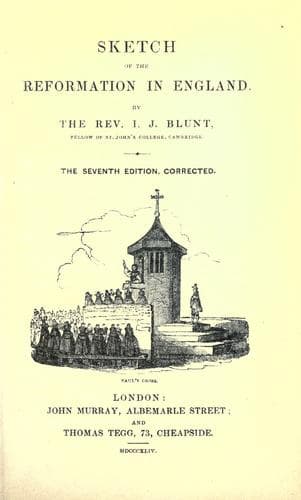
Sketch of the Reformation in EnglandBlunt, John J. (John James)
History
Sketch of the Reformation in England
Blunt, John J. (John James)
Great Britain -- Church history; Reformation -- England
exchanges with the see of Canterbury, which the King himself proposed,
Cranmer endeavoured to protect it in its just rights by soliciting
Cromwell’s opinion of the terms, “forasmuch as he himself was a man
that had small experience in such cases, and had no mistrust at all in
his prince;”[407] and thus did he dexterously contrive to uphold and
transmit to his successors an ample revenue in most dangerous times;
and under a most despotic monarch. But the name of Edward could not be
interposed with the same success between the nobles and their pleasure,
and accordingly the see of Canterbury, nor that alone, is said to
have suffered more under Edward than under Henry himself; for the old
cry was raised of the luxury and covetousness of churchmen, and the
old precedents of dispensing half a dozen prebends to one earl, and
a deanery to another, (such had been the predicament of the Earl of
Hertford, and of Cromwell,)[408] were again acted upon; and laymen were
pensioned out of the bishoprics as they successively fell vacant;[409]
and many of the best estates were taken away, so that the wealthiest
sees could scarcely maintain their diocesans;[410] and scholars were
supplanted in the rewards of learning by their superiors in birth,
to the decay of the universities and of letters in general; so that
Ridley, now Bishop of London, Bonner having been deposed, being about
to give Grindal a prebend in St. Paul’s, is prevented by the council,
it being their pleasure that the King should have it for the furniture
of his stable, an indignity of which he loudly complains to Cheke, the
King’s tutor, urging him to speak out upon it in the proper quarter,
or to let that his letter speak.[411] Nor was this all; commissioners
were despatched into every part of England in the last year of
Edward, to gather such gleanings as were still left in the shape of
chantry-lands unsold, and furniture of churches; they were themselves,
however, commonly forestalled by the people, so that, according to
Heylyn, “many private men’s parlours were now hung with altar-cloths,
their tables and beds covered with copes instead of carpets and
coverlids, and many made carousing cups of the sacred chalices, as
once Belshazzar celebrated his drunken feast in the sanctified vessels
of the Temple.”[412] Thus the locusts took what had escaped from the
hail. How much further this dissipation of church property would have
been carried had Edward continued longer to fill the throne, it is
impossible to tell; certain it is, that it received a check from the
restoration of the Roman Catholic religion, for a season, under Mary;
and amongst the mysterious ways in which Providence works out its own
ends, that otherwise fatal reign might be the appointed barrier for
securing a reasonable provision still for the Church of England, and
thereby an efficient, because an intelligent and independent, clergy.
For the Roman Catholic party began now to be enlisted by the dictates
Public-domain text, read in full here on John Shaqi.
Reviews
Reviews
No reviews yet
Be the first to share your thoughts on this work.
Elsewhere in the archive
Join the Discussion
Join the discussion
Sign in to leave a comment or review.
Sign InorCreate an account