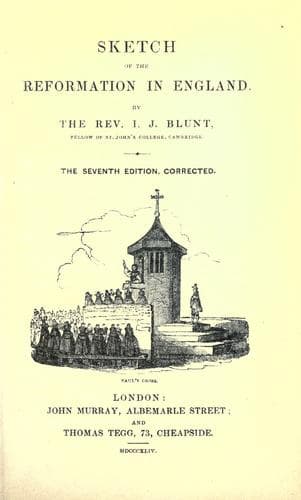
Sketch of the Reformation in EnglandBlunt, John J. (John James)
History
Sketch of the Reformation in England
Blunt, John J. (John James)
Great Britain -- Church history; Reformation -- England
word, which for the space of twelve years” (the term of Cranmer’s
acquaintance with him) “he had always been ready to promote in his
country, not rashly nor seditiously, but gently and soberly; _so that
his own country could neither greatly hate him nor love him_. They
could not hate him, for his kindness and gentleness, being ready to
do every man good as much as in his power was; and yet they could not
heartily love him, because he ever commended the knowledge of God’s
word, studied it himself diligently, and exhorted them unto the same;
and spake many times against the abusions of the clergy, for which
he had all the hate that most of the clergy could procure against
him.”[404] A character of this complexion, moderation the leading
feature of it, was not the one to win upon a patron, himself prepared
to rush into the extremes of the Puritans.
But the reign of a minor, which was favourable to the growth of
that party, indeed Edward had himself, perhaps, a leaning to their
opinions, was not unfriendly to the further pillage of the church.
Here, therefore, Cranmer had again to interpose, that in this instance
he might protect the temporalities, as in the other he had protected
the doctrines, of the Establishment. The division of the abbey-lands
amongst the nobles seems to have begot a general taste amongst the
upper classes for expense, and consequent appetite for spoil--it
grew by what it fed on. Rents were raised to an extravagant height;
the farm for which Latimer’s father paid from three to four pounds
a year; and which enabled him to send a man and horse to the King’s
service, and to portion his daughters with five pounds a-piece, was,
in Latimer’s own time, let for sixteen pounds or more, to the utter
impoverishment of the occupier.[405] The waste lands were every
where enclosed for sheep-walks (the wool trade having now become
considerable), to the annihilation of those ancient rights of pasturage
which the neighbouring peasantry enjoyed, and to the fomentation of
fierce rebellions throughout the country.[406] Now it happened that
the chantries or chapels endowed by individuals for private masses had
survived the spoliation of Henry: these it was proposed should be given
to the King (which was another word for the nobles through the King),
and an act of parliament to that effect was passed in 1547, in spite
of the opposition of the bishops, and of Cranmer above all, who had
been in hopes of reserving these endowments till Edward should come of
age, and then inducing him to assign them to the relief of the numerous
poor clergy whom the sale of tithes had left almost pennyless. He had
already resisted encroachments of the same kind under Henry; beseeching
him that there should be no alienation of church lands without the
production, at least, of the royal warrant; many of the nobles being
in the habit of seizing them in the King’s name, though without any
intention of appropriating them to the King’s use. Moreover, in those
Public-domain text, read in full here on John Shaqi.
Reviews
Reviews
No reviews yet
Be the first to share your thoughts on this work.
Elsewhere in the archive
Join the Discussion
Join the discussion
Sign in to leave a comment or review.
Sign InorCreate an account