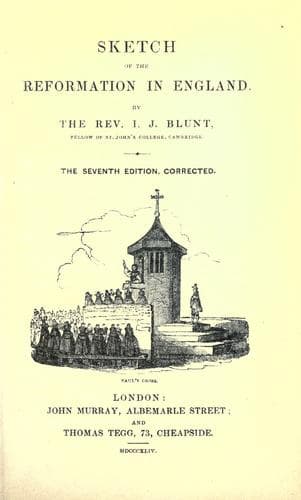
Sketch of the Reformation in EnglandBlunt, John J. (John James)
History
Sketch of the Reformation in England
Blunt, John J. (John James)
Great Britain -- Church history; Reformation -- England
at last, over-persuaded by the authority of the judges, all of whom
except Judge Hales, concurred in it, and above all, by the entreaties
of Edward himself, who represented the hopeless condition to which the
Reformation would be reduced by acquiescing in the natural descent of
the crown, (as if the wrath of man was to work the righteousness of
God,) in an evil hour he took the pen and signed the document and what
was tantamount to his own death-warrant together.
And now Edward, having finished his short but saintly course, his
sixteenth year not yet completed, commended his people to God,
especially beseeching him that he “would defend his realm from
papistry;” and then as he sunk in the arms of Sir Henry Sidney, he
exclaimed, “I am faint; Lord, have mercy on me; and receive my spirit;”
and so he departed. Thus ended this reign of mercy: for ill as the
principle of toleration was in those days understood, violently as it
had been outraged by Henry, who preceded, and as it was destined to be
by Mary, who followed him, during the six years that Edward sat upon
the throne, neither in Smithfield, nor in any other quarter of the
realm did any man suffer for religious opinion, whether Catholic or
Protestant, save the two of whom mention has been made already--the
Dutchman and Joan of Kent.[419] And even in cases of imprisonment and
deprivation, as in those of Bonner, Bishop of London, and Gardiner,
Bishop of Winchester, the parties were proceeded against rather as
political than religious delinquents, rather as rebels than heretics;
a doctrine being sedulously taught by these and other leaders of the
Catholic party, and echoed back both by the Princess Mary and by the
insurgents of Devon, that neither were the decrees of the council
binding, the regal power not being transferable, nor yet those of the
King, he being still a minor; wherefore, that the laws of the land,
as Henry left them, were those which were to be obeyed until the king
should come of age, and none other.[420] It is obvious that such a
principle, generally acknowledged and acted upon, would have ended
in leaving the country without any government at all; for if the old
statutes should prove inapplicable to an unforseen emergency, and
there were no authority adequate to supply the defect, anarchy must
ensue. It is true that advantage was sometimes taken of overt acts of
non-conformity on which to prosecute, because where there might be
moral, there might not be legal, evidence of disaffection, the offence
being difficult of proof; still here the gravamen no doubt lay of many
of the charges preferred against the Roman Catholic dignitaries, and
of the penalties inflicted on them in the reign of Edward; and the
necessity which lay upon the council of seeing that the commonwealth
took no damage at their hands in those dangerous times, may be thought
to excuse proceedings which, however, were attended by some aggravating
circumstances of rigour but too common in those days.
Public-domain text, read in full here on John Shaqi.
Reviews
Reviews
No reviews yet
Be the first to share your thoughts on this work.
Elsewhere in the archive
Join the Discussion
Join the discussion
Sign in to leave a comment or review.
Sign InorCreate an account