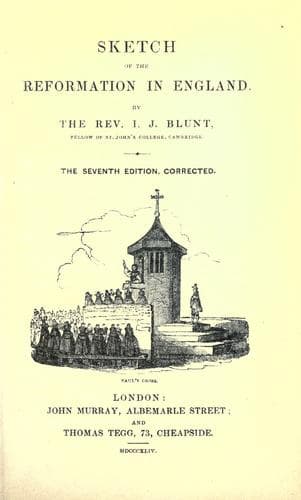
Sketch of the Reformation in EnglandBlunt, John J. (John James)
History
Sketch of the Reformation in England
Blunt, John J. (John James)
Great Britain -- Church history; Reformation -- England
This was a county, in which, for whatever reason,
the Reformation seems to have taken an earlier and deeper root than
elsewhere; and accordingly, the Reformers of Suffolk, before they
declared for Mary against the Lady Jane, stipulated for liberty of
opinion in religious matters, to which proposal a “very hopeful answer”
was given:--She meant graciously not to compel or strain other men’s
consciences otherwise than God should, as she trusted, put in their
hearts a persuasion of the truth, through the opening of his word unto
them.” But no sooner was she firm in her seat, than she repeats the
concession in an artful proclamation, with the ominous addition, “until
such time as further order by common assent may be taken therein.”[422]
And, accordingly, Suffolk was soon to see the faggot lighted within
her borders, and men and women to be baptized with fire. Mary, indeed,
like her father, was of an unforgiving spirit: the memory of Cranmer’s
benefit had perished; and though, at length, he was absolved from the
charge of treason, a boon which could scarcely be refused to him when
it had been conceded to many others far more deeply implicated than
himself, it was only that he might be put upon his trial for heresy; a
commutation, which, however satisfactory to his feelings, was likely
to be equally fatal to his life, a merciful substitution of the stake
for the scaffold, and little more: for now the chief instruments of
the Roman Catholic party were again in activity; and the sword was
commanded to go through the land. Gardiner, again Bishop of Winchester,
in the room of Poynet, and now lord chancellor, and Bonner, Bishop of
London, for Ridley was deposed, began once more to play their tragical
parts, and whatever could be done by the most politic and the most
blood-thirsty of men to put the Reformation down was unscrupulously
adopted. Preachers were every where watched, in order that advantage
might be taken of any heretical doctrines which might escape them;
and the bird of the air told the matter, and denounced them to the
council, by whom they were silenced or imprisoned. Instructions,
moreover, were sent to all the bishops to deprive the married clergy
of their benefices, and to suspend them from officiating in a church;
an edict, by which, according to a computation of Archbishop Parker,
three fourths of all the ministers in England, according to others,
not more than one fourth, were ejected;[423] whilst the principle of
the measure confining its operation chiefly, though not entirely, to
such as maintained the opinions of the Reformers, caused the pulpits
throughout the country, at one swoop, to be again surrendered, in
whole, or in great part, to a Roman Catholic priesthood. From the
accession of Mary, which was in July, to the assembling of her first
parliament in October, there had been an unequal struggle continued
between the old and new forms of faith. It should seem that the feeling
Public-domain text, read in full here on John Shaqi.
Reviews
Reviews
No reviews yet
Be the first to share your thoughts on this work.
Elsewhere in the archive
Join the Discussion
Join the discussion
Sign in to leave a comment or review.
Sign InorCreate an account