Sketch of the Reformation in EnglandBlunt, John J. (John James)
History
Sketch of the Reformation in England
Blunt, John J. (John James)
Great Britain -- Church history; Reformation -- England
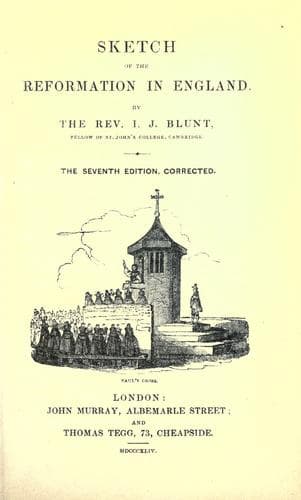
of London had from the first set in for the Reformation. A preacher
at Paul’s Cross,[424] who had ventured to disparage Edward’s memory,
whilst making his court to Bonner, who was one of his hearers, excited
an uproar amongst the people which nearly cost him his life. A queen’s
guard was afterwards in attendance to protect the pulpit; and an order
was issued by the mayor, that the ancients of all companies should
be present, lest the preacher should be discouraged by his small
auditory.”[425] Still in the country the cause of the Pope was far
the more popular; custom pleaded for it; its pageants were agreeable
to the taste of the million; some hope, too, might be entertained of
the recovery of the rights of pasturage, if the abbeys were restored,
and of the charities and hospitalities, which had ceased to flow
since the suppression: then the disposition of the Queen was known
before she positively proclaimed it by her policy; her own practice
was enough to prove her future intentions; and such persons as were
of a neutral character, a very large class in every country, went
over to her side: above all, the Roman Catholic clergy, stimulated by
the recollection of past wrongs (as they would naturally hold), and
alive to the prospect of good things in store for them, put forth all
their strength; so that the parliament now assembled made no scruple
of reversing all the proceedings (save one) of the two former reigns,
and Mary became at once supreme, and her church once more dominant.
The single point to which the parliament, so compliant in points of
doctrine, was resolutely opposed, was a proposal for a relinquishment
of the abbey lands. This met with a vigorous resistance from their
present possessors; and Cromwell’s sagacity was now perceived when
he bound over the leading families of every county to keep the faith
delivered to them, in securities of their newly-acquired estates.
Mary, however, did not preach what she was not prepared to practise;
for her sincere and disinterested devotion to the Roman Catholic
persuasion was the virtue, the passion it might be rather said, of
her life; the piety of her mother had imparted to her in her cradle
a faith, which the subsequent sufferings of that mother must have
hallowed in her sight. She, therefore, with no selfish or secular
purpose, restored of her own free will whatever abbey lands had been
attached to the crown,[426] as well as the first-fruits and tenths,
a branch of papal revenue which Henry had indeed seized, but which
never, it was suspected, passed beyond the hands of Pole, the sole
commissioner for the disposal of it.[427] By Elizabeth, who succeeded
to an exhausted exchequer, it was resumed; nor was it finally restored
to the church, till Queen Anne, as we have said in a former chapter,
generously appropriated it to ecclesiastical purposes; and accordingly
it is now known under the name of Queen Anne’s Bounty, as a fund for
the augmentation of small livings.
Public-domain text, read in full here on John Shaqi.
Reviews
Reviews
No reviews yet
Be the first to share your thoughts on this work.
Elsewhere in the archive
Join the Discussion
Join the discussion
Sign in to leave a comment or review.
Sign InorCreate an account