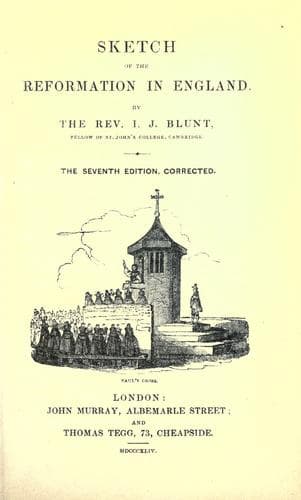
Sketch of the Reformation in EnglandBlunt, John J. (John James)
History
Sketch of the Reformation in England
Blunt, John J. (John James)
Great Britain -- Church history; Reformation -- England
the everlasting pain_, if by their end we may judge.”[441] The man
who could write thus can scarcely lay claim to our credence; for his
prejudice has evidently stifled in him every sense by which a regard
for truth can be guaranteed.
It is not thought out of place to introduce here this brief vindication
of a book, which, so far as it is a contemporary history, has been,
both of old, and of late an object of unfair depreciation, but from
which no right-hearted Protestant can rise, without being at once a
sadder and better man;--a book, out of which we shall now fearlessly
draw our information, whilst we offer to our readers a few examples of
those terrible sufferings which it is at once humiliating to think that
man could inflict, and animating to think that man could so nobly bear.
The first called to take up his cross was John Rogers. He had been
brought up in Cambridge, and afterwards became chaplain of the
factory at Antwerp, where he fell into the company of Tindall and
Coverdale, and helped them to produce that translation of the Bible,
which goes by the name of Matthew’s translation. He thence removed to
Wittenberg, where he had the charge of a congregation for many years,
till Edward’s accession having rendered it safe for those who held
his opinions to return to their native land, he repaired thither with
his wife and children (for he was married), and was soon preferred by
Ridley to a prebend of St. Paul’s and to the divinity lectureship in
that cathedral. Thus was he in a situation to attract the attention
of Mary, and to be smitten by her evil eye. Accordingly, he was soon
brought before the council to answer for his doctrine; and having been
first confined to his house, where he remained half a year, and from
which he took no pains to escape, he was afterwards, by the tender
mercies of Bonner committed to Newgate, and lodged amongst the common
desperadoes of a gaol for twelve months more. In his examinations
before Gardiner and the council he played his part with the intrepidity
of one who felt strong in the righteousness of his cause, and with a
force of reasoning which it required the scoffs and brutal laughter of
his judges to smother, for answer it they could not. Kneeling on his
knees, he reminded them of their own acquiescence in the laws of Henry
and Edward; one amongst them, and he, the chief, having been the open
advocate of the King’s supremacy as opposed to that of the Pope. He
defended his own marriage, as being originally contracted in a country
where marriage was permitted to priests; and said that neither did
he bring his wife into England till the laws of England permitted it
too. With regard to service in an unknown tongue, and the doctrine
of the mass, he stayed himself upon Scripture. Gardiner exclaiming
against him, that “he could prove nothing by the Scripture, for that
Scripture was dead, and must needs have a lively expositor.” But all
was in vain, for they were bent to have his life, and having been on
Public-domain text, read in full here on John Shaqi.
Reviews
Reviews
No reviews yet
Be the first to share your thoughts on this work.
Elsewhere in the archive
Join the Discussion
Join the discussion
Sign in to leave a comment or review.
Sign InorCreate an account